¶ Main modules
- Overview
- How the toggles work
- Example: disabling a module
- Finance
- Tariff plans
- Customers
- Networking
- Leads
- Tickets
- Inventory
- Scheduling
- Voice
- Related pages
¶ Overview
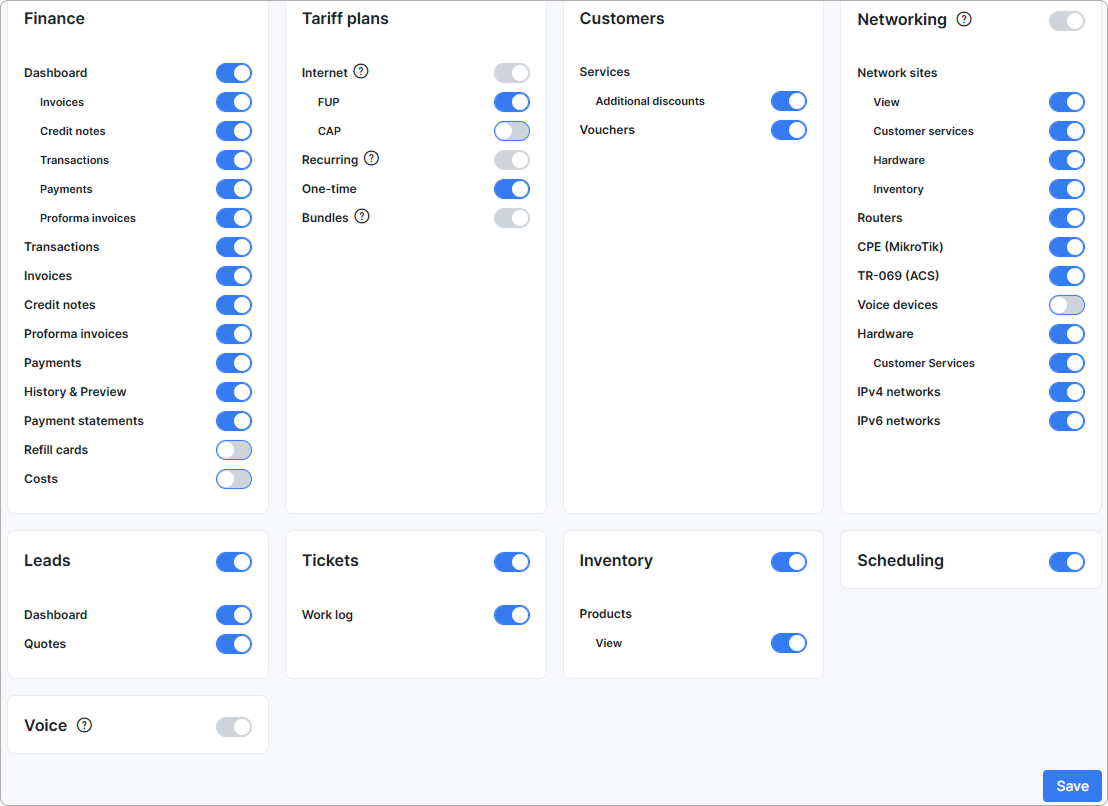
Main modules is where you decide which parts of Splynx your team actually sees. Modules and features you do not use can be switched off, which removes them from the navigation pane and keeps the interface focused on the work your ISP does.
To open it, go to Config → Integrations → Main modules:

The page is laid out as a set of cards, one per module — Finance, Tariff plans, Customers, Networking, Leads, Tickets, Inventory, Scheduling and Voice. Each card lists the features that module provides, each with its own toggle.
Be careful with these settings! Switching a module off hides it from every administrator, not just from you.
¶ How the toggles work
Three kinds of toggle appear on this page:
- Module toggle — the switch in a card's header (for example on Networking or Voice). It turns the whole module on or off.
- Feature toggle — a switch in the card body. It controls one page or one feature inside that module.
- Nested toggle — a switch indented under a feature toggle. It controls a part of that feature and is only relevant while the parent feature is enabled.
A few points worth knowing before you change anything:
- Not every card has a module toggle. Finance, Tariff plans and Customers are core to Splynx, so their individual features can be switched off but the module itself cannot.
- Disabling a module or feature hides it — it does not delete anything. Existing records stay in the database and reappear when you switch the module back on.
- The card itself never disappears from Main modules, whatever state its toggles are in, so you can always switch a module back on.
- A question mark icon next to a module name opens a hint explaining what the module does or what has to be in place before it can be disabled. Hover over it to read the hint.
- Changes take effect after you click
Save.
¶ Example: disabling a module
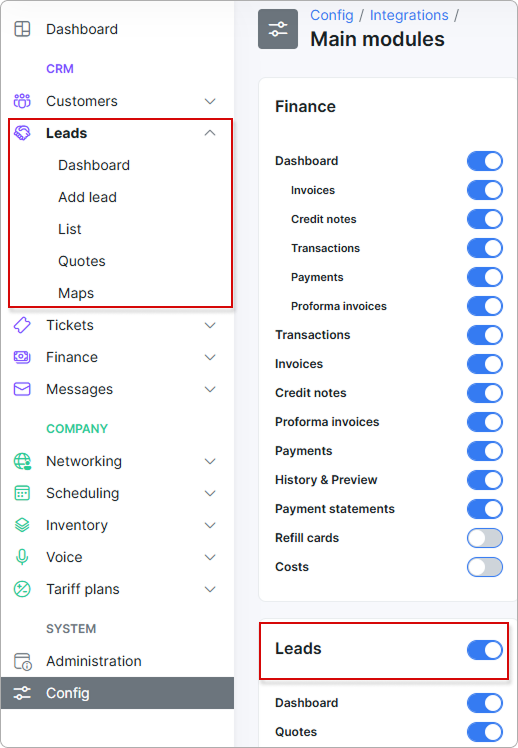
The Leads module is enabled here, so Leads is listed in the navigation pane:
If your ISP does not work with leads, switch the module off and click Save:
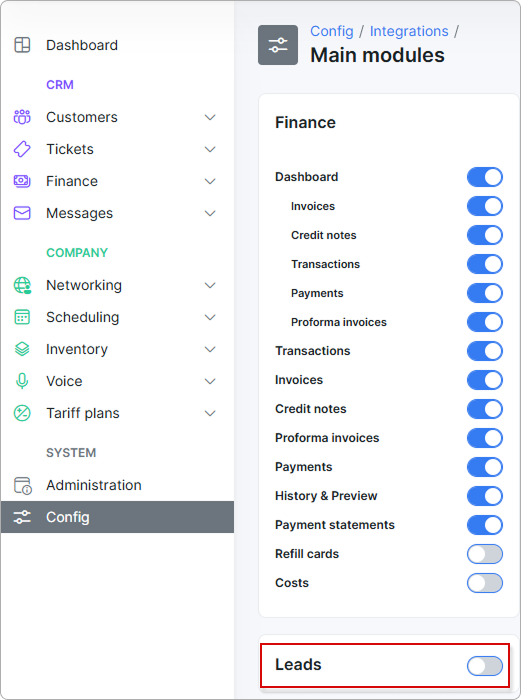
Leads disappears from the navigation pane. The Leads card stays on the Main modules page, so you can switch the module back on whenever you need it — the leads already in the system are untouched.
¶ Finance
The Finance module covers billing documents and money movement. It has no module toggle — its features are managed individually.
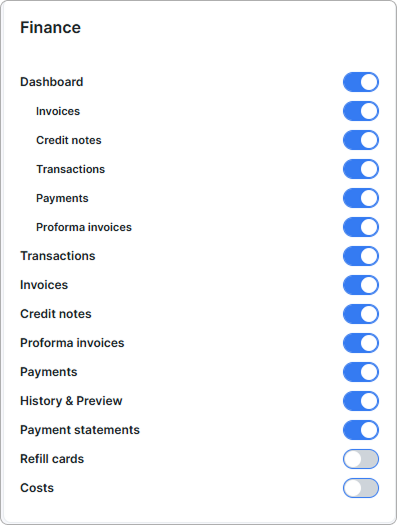
- Dashboard - the Finance dashboard with its summary blocks. The toggles nested under it choose which blocks the dashboard shows: Invoices, Credit notes, Transactions, Payments and Proforma invoices.
- Transactions - the list of financial transactions.
- Invoices - customer invoices.
- Credit notes - credit notes issued to customers.
- Proforma invoices - proforma (advance) invoices.
- Payments - recorded customer payments.
- History & Preview - the change history and document preview available on finance documents.
- Payment statements - customer payment statements.
- Refill cards - prepaid refill cards customers redeem to top up their balance.
- Costs - cost records used to track expenses against revenue.
¶ Tariff plans
The Tariff plans module holds the plan types you sell. Switching a plan type off hides it from the tariff plan menu and from the service forms, so administrators cannot create new services of that type.
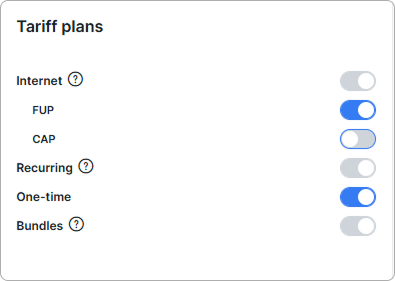
- Internet - internet tariff plans. Two nested toggles refine it:
- FUP - Fair Usage Policy rules that adjust a customer's bandwidth once they pass a usage threshold.
- CAP - capped plans, which limit how much data a customer may use in a billing period.
- Recurring - plans for non-internet services billed on a cycle, such as IPTV, hosting or equipment rental.
- One-time - plans for charges billed once, such as installation or callout fees.
- Bundles - bundle plans that combine several tariff plans into a single offering at a combined price.
A plan type cannot be disabled while customers still have active services of that type. Hover over the question mark icon next to the plan name for the exact condition.
¶ Customers
The Customers module is always enabled, since customers are central to Splynx. Only the optional features around them can be switched off.
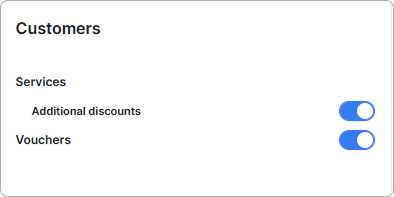
- Services - groups the optional settings that apply to customer services.
- Additional discounts - the separate percentage discounts that can be added on top of a service's main discount, each with its own dates and message.
- Vouchers - prepaid vouchers customers use to pay for services.
¶ Networking
The Networking module covers network infrastructure and the devices you manage. The module toggle in the card header switches all of it on or off at once.
If you have internet services, to disable this module, you need to change status of service to archive or delete them.
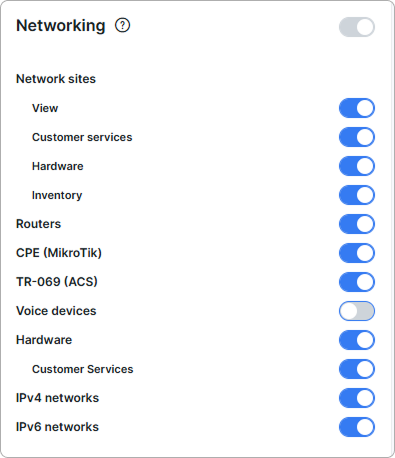
- Network sites - the network sites where your equipment is installed. The nested toggles choose which tabs a network site shows:
- View - the site's overview tab.
- Customer services - the services delivered from that site.
- Hardware - the hardware installed at the site.
- Inventory - the inventory items assigned to the site.
- Routers - the routers Splynx manages for authentication and traffic shaping.
- CPE (MikroTik) - customer premises equipment managed through the MikroTik API.
- TR-069 (ACS) - device management through the built-in ACS (Auto Configuration Server) using the TR-069 protocol.
- Voice devices - the devices used for voice services.
- Hardware - the hardware inventory of network equipment.
- Customer services - links hardware records to the customer services they serve.
- IPv4 networks - IPv4 address pools and their allocation.
- IPv6 networks - IPv6 address pools and their allocation.
¶ Leads
The Leads module is the CRM pipeline for potential customers who have not been converted yet.
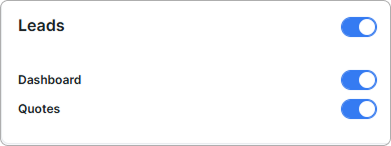
- Dashboard - the Leads dashboard with the pipeline summary.
- Quotes - sales proposals prepared for a lead before it converts to a customer.
¶ Tickets
The Tickets module is the Helpdesk. The module toggle controls whether Tickets appears in the navigation pane at all.
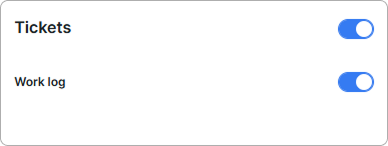
- Work log - when enabled, administrators can log the time they spend on each ticket message. A Time spent (minutes) field appears on the reply and note forms of a ticket, the running total is shown as Total time spent on the ticket's right-hand panel, and the entries feed the Helpdesk worklog reports.
The Work log toggle was located under Config → Helpdesk → Tickets (Miscellaneous) in earlier versions. Only the location of the switch changed — the feature itself works exactly as before.
¶ Inventory
The Inventory module tracks stock, equipment and the items assigned to customers or network sites.
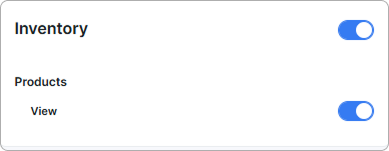
- Products - the products you keep in stock and sell or hand out to customers.
- View - the product detail view.
¶ Scheduling
The Scheduling module covers projects and tasks, including the scheduled tasks used to auto-assign tickets to administrators on shift. It has a module toggle only — there are no separate feature toggles.

¶ Voice
The Voice module covers voice services, call detail records and voice billing.

If you have voice services, you need to archive or delete them to disable this module.