¶ Custom pricing & discounts
- Overview
- Filters
- Which services appear in the report
- Table
- How to read a row
- Export and column customization
- Important notes
- Related pages
¶ Overview
The Custom pricing & discounts report lists every active customer service whose price has been adjusted from the standard tariff — either because the service has a custom unit price, or because a discount of any kind is currently in effect. Use it to audit which customers are paying less (or more) than the standard tariff, which negotiated promotions are still active, and where renewals or cleanup are due.
The report is a snapshot as of today's date: a service appears only if at least one of its triggers — custom unit price, service-level discount, or additional discount — is in effect right now. Anything that ended yesterday or starts tomorrow is not listed.
To open the report, go to Administration → Other reports → Custom pricing & discounts.

Access to this report is limited to administrators with the Super administrator role.
¶ Filters
Both filters at the top of the page narrow which services appear in the result. The report is empty until you click Show.

- Partner — limits the result to services belonging to customers in the selected partners. Multi-select; the default is All selected. If your admin account is restricted to a single partner, the report is automatically scoped to that partner and the filter cannot be widened.
- Location — limits the result to services belonging to customers in the selected locations. Multi-select; the default is All selected.
After adjusting the filters, click Show to refresh the table.
¶ Which services appear in the report
A service is included in the report if all of these are true:
- The customer is not deleted.
- The service is not deleted and its status is Active.
- The service is not a child of a bundle. Bundle child services are skipped — the parent service is reported instead.
…and at least one of the following is also true today:
- Custom unit price — the service's unit price is different from the price of its tariff plan. A higher unit price (markup) also counts, not only a lower one.
- Service-level discount is in effect — the service has its main discount enabled, the discount value is non-zero, and today falls inside the discount's start/end window. An empty start or end date means there is no lower or upper bound on that side.
- Additional discount is in effect — the service has at least one additional percentage discount that is enabled, not deleted, has a non-zero percent, and whose start/end window covers today (with the same open-ended date logic).
If none of those is true, the service is not shown — even if it had a discount in the past or will have one in the future.
The Internet section is included only when the Internet module is enabled in the system.
¶ Table
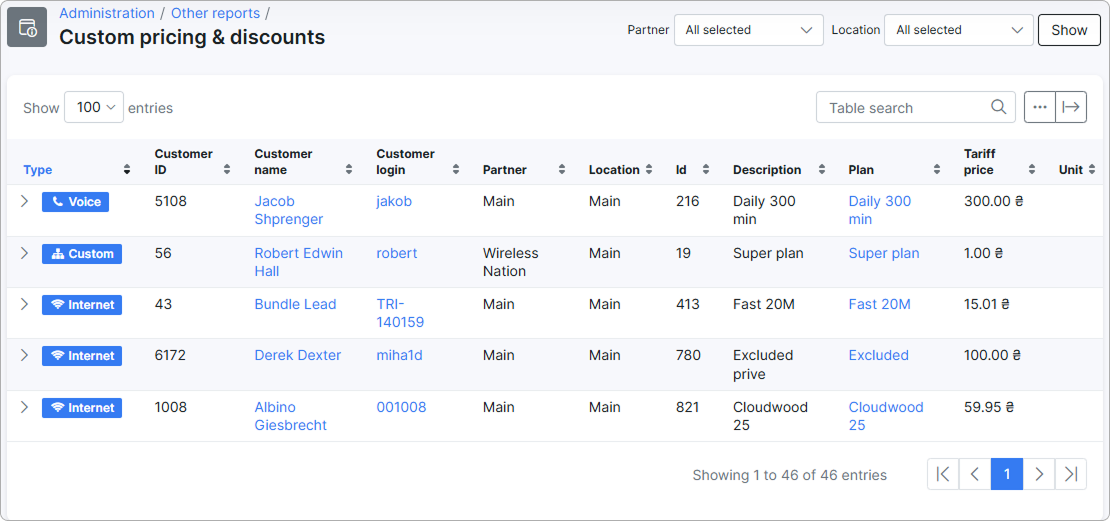
Each row is one customer service that meets the inclusion rules above. The default sort is by Type. Click any column header to sort by that column.
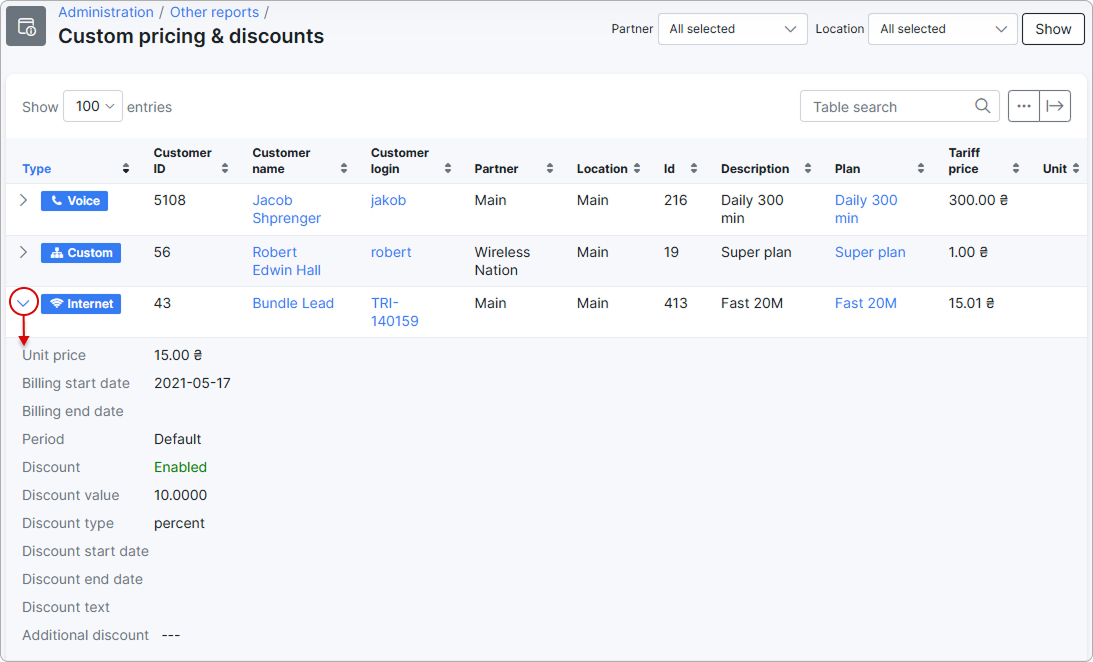
The leftmost arrow on each row expands an inline detail panel with the discount fields for that service.
| Column | Description |
|---|---|
| Type | Service category, shown as a colored badge: Internet, Voice, Custom (Recurring), or Bundle. |
| Customer ID | Internal customer ID. Links to the customer card. |
| Customer name | Customer's full name. Links to the customer card. |
| Customer login | Customer's login. Links to the customer card. |
| Partner | Partner the customer belongs to. |
| Location | Location the customer belongs to. |
| Id | Service ID — unique within the customer's services. |
| Description | Service description as set on the customer card. |
| Plan | Name of the tariff plan assigned to the service. Links to the tariff view. |
| Tariff price | Standard catalog price of the assigned tariff plan, in system currency. This is the baseline against which the unit price is compared. |
| Unit | Unit of measurement attached to the price (when the tariff plan defines one). |
| Unit price | Actual price billed for this service. If this differs from Tariff price, the service qualifies for the report on that basis alone. |
| Billing start date | Date the service started being billed. |
| Billing end date | Date the service stops being billed (empty for open-ended services). |
| Period | Billing period of the service (for recurring services). |
| Discount | State of the main service-level discount: Enabled (green) or Disabled (red). A row can show Disabled and still appear in the report if a custom unit price or an additional discount put it there. |
| Discount value | Numeric amount of the main service-level discount. |
| Discount type | How the discount value is interpreted — Fixed (a money amount taken off the unit price) or Percent (a percentage taken off). |
| Discount start date | First day the main discount is in effect. Empty means open-ended on that side. |
| Discount end date | Last day the main discount is in effect. Empty means open-ended on that side. |
| Discount text | Description or message saved with the main discount. |
| Additional discount | Text summary of every additional discount currently active for the service: percent, start date, end date, and message. --- means there is no additional discount. |
The default view shows the basic columns; expand the row to see the discount fields, or use the column-customization dialog to add them to the main grid (see Export and column customization).
¶ How to read a row
For each row, three pieces of information explain why the service is in the report. Compare them in this order:
- Tariff price vs Unit price — if they differ, the customer is on a custom (negotiated) price for this service. The difference can be a discount or a markup; the report surfaces both.
- Discount column and the discount fields — if Discount is Enabled, the value is non-zero, and today is inside the Discount start date / Discount end date window, a service-level discount is currently being applied. The combination of Discount value + Discount type tells you whether it is a fixed money amount or a percentage off the unit price.
- Additional discount column — if it lists one or more entries, those are extra percentage discounts on top of the unit price, also active today.
A service can satisfy more than one trigger at once — for example, a customer might have both a custom unit price and a percentage additional discount layered on top.
The discount values shown are stored on the service. The report does not recompute the customer's invoice — to see the final billed amount, open the customer's services or invoices.
¶ Export and column customization
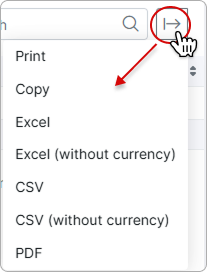
Use the export button  above the table to copy the data or download it. Available formats:
 Print, Copy, Excel, Excel (without currency), CSV, CSV (without currency), PDF. The "without currency" options remove currency formatting from money columns, which is useful when feeding the file into another system.
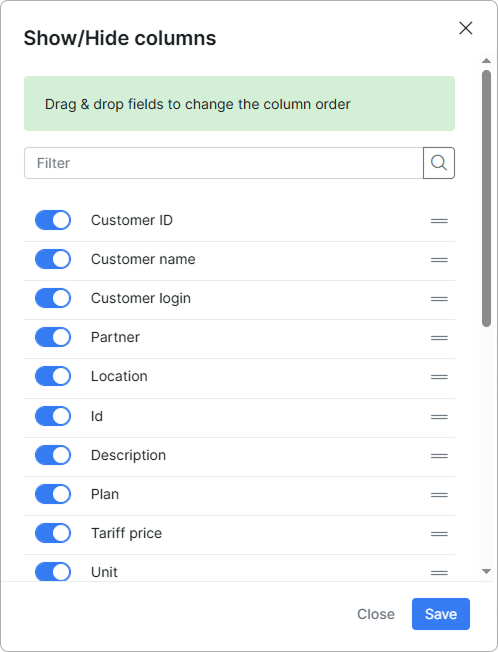
Use the column customization button  to choose which columns are visible and to reorder them. Toggle the checkbox next to a column to show or hide it, drag a row to change its position, then click
 Save.
The full list of columns the report can produce: Customer ID, Customer name, Customer login, Partner, Location, Id, Description, Plan, Tariff price, Unit, Unit price, Billing start date, Billing end date, Period, Discount, Discount value, Discount type, Discount start date, Discount end date, Discount text, Additional discount.
¶ Important notes
- Today is the cutoff. A discount that ended yesterday is not shown; a discount that starts tomorrow is not shown either.
- Inactive or deleted services are excluded. Only services with status Active are evaluated.
- Bundle child services are not listed individually — only standalone services and bundle parents appear.
- Soft-deleted additional discounts are ignored, even if their date window still covers today.
- A custom unit price alone is enough to include a service, even when the service-level discount is Disabled and the discount value is
0.