¶ Customer contracts report
- Overview
- Common table columns
- Contracts pending signature
- Expiring
- Signed
- Rejected
- How values are calculated
- Filter by period
- Table management
- Important notes
- Related pages
¶ Overview
Use the Customer contracts report to keep track of every sign-type contract attached to a customer across its full lifecycle — from generation, through signing, to renewal or rejection. The report answers four routine questions for an ISP admin: What is still waiting to be signed? What is about to expire? What was signed this period? What was rejected this period?
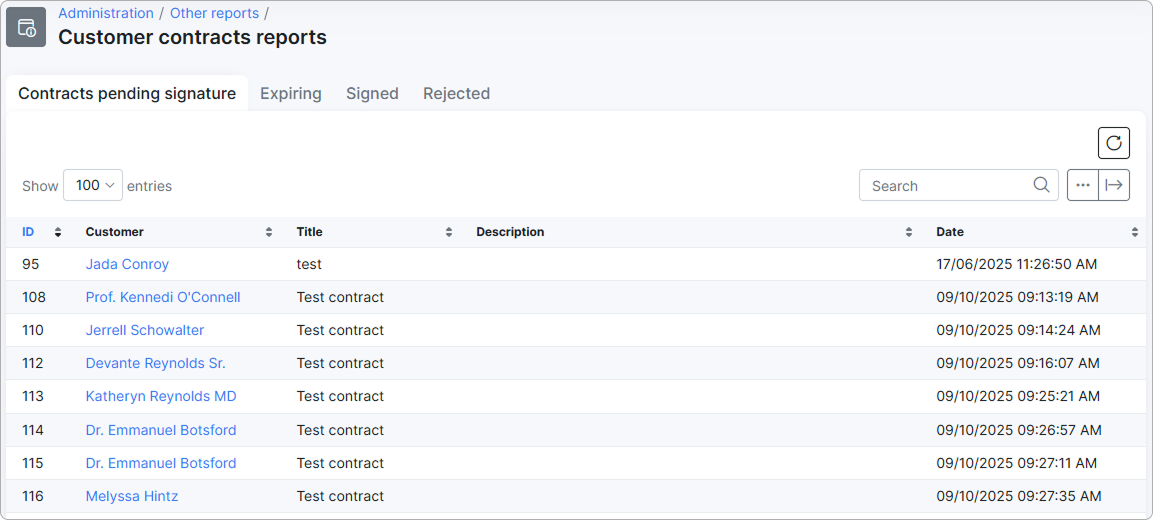
Each of these questions is answered by a separate tab; all four tabs draw from the same pool of customer contract documents (the ones attached on Customers → Documents with the Sign contract option enabled). Plain uploaded files and generated (non-sign) documents are not included in this report.
To open the report, go to Administration → Other reports → Customer contracts reports.

The report is available to administrators with the Super-administrator, Administrator, Manager, or Financial manager role.
¶ Common table columns
Every tab shows the same first four columns, then adds one tab-specific date column:
| Column | Description |
|---|---|
| ID | Internal identifier of the contract document. |
| Customer | The customer the contract belongs to. Clicking the name opens the customer's profile. |
| Title | The contract's title, as entered when the document was generated. |
| Description | The contract's description (optional). Empty if no description was provided. |
The tab-specific date column changes per tab — see each tab section below.
¶ Contracts pending signature
What it answers: which contracts have been generated but not yet signed by the customer.
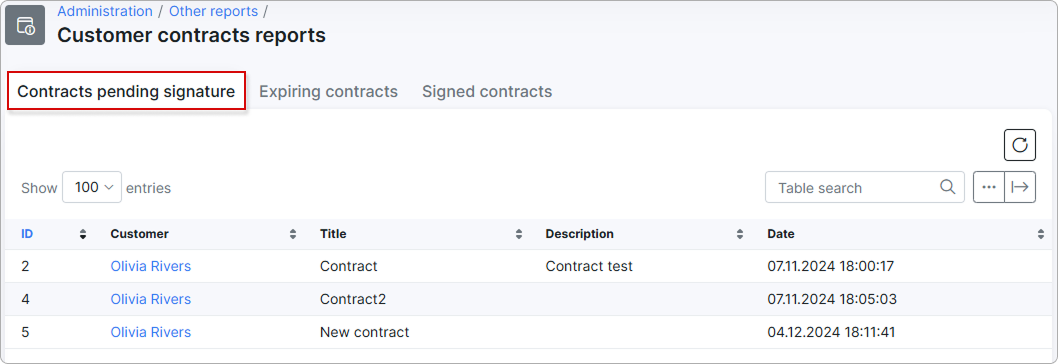
This tab lists every contract document that has the Sign contract option enabled and does not yet have a signature recorded — regardless of when it was created. There is no period filter on this tab, so you see the full backlog of outstanding signatures.
The tab-specific column is:
- Date — the date and time the contract was generated. Use it to see how long a contract has been waiting for the customer's signature.
¶ Expiring
What it answers: which signed contracts will reach the end of their term within the selected period.
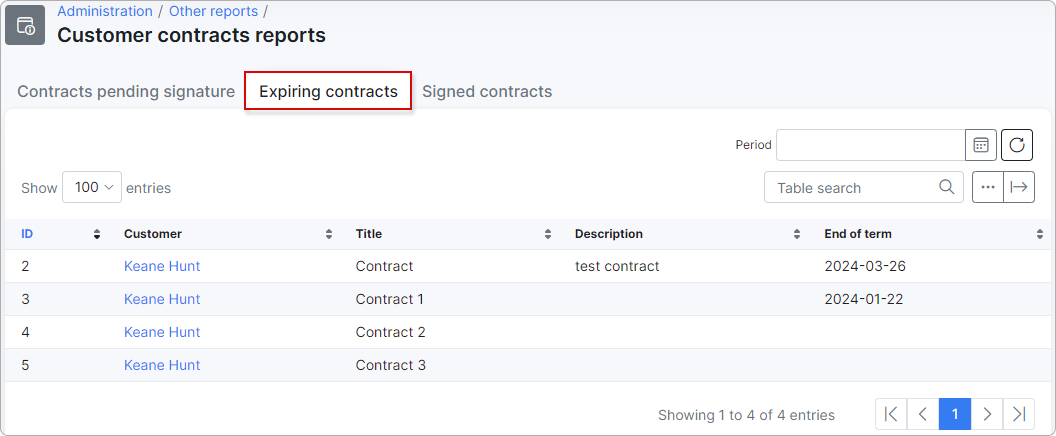
This tab is driven by a period filter (defaults to the current month). A contract appears here when its end-of-term date falls inside the selected period. The end-of-term date is calculated, not stored — see How values are calculated.
The tab-specific column is:
- End of term — the date the contract's term expires. If that date is already in the past, a yellow Expired badge is shown next to it.
Use this tab to plan renewals — for example, run it for next month to see which contracts you need to re-sign before they expire.
¶ Signed
What it answers: which contracts were signed by customers during the selected period.
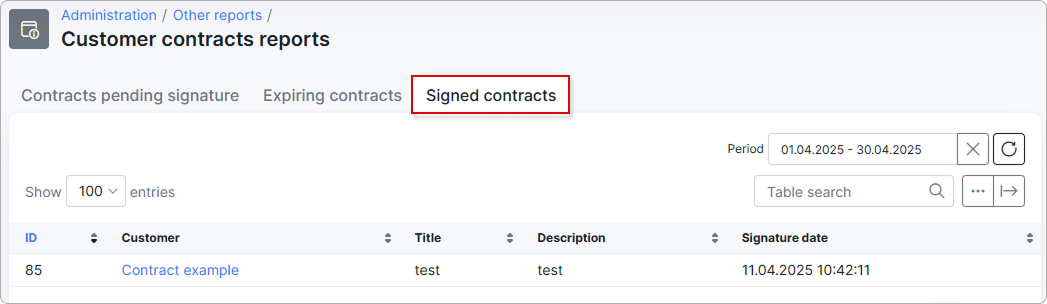
A contract appears here when its signature date — the moment the signing flow was completed and the signed PDF was stored — falls inside the selected period. The period filter defaults to the current month.
The tab-specific column is:
- Signature date — the date and time the customer completed the signing flow.
Use this tab as a "contracts closed this month" view — for example, to count how many contracts you finalized in a quarter.
¶ Rejected
What it answers: which contracts were rejected during the selected period.
A contract appears here when its status was set to Rejected and the rejection timestamp falls inside the selected period. The period filter defaults to the current month.
The tab-specific column is:
- Rejected date — the date and time the contract moved to the Rejected status.
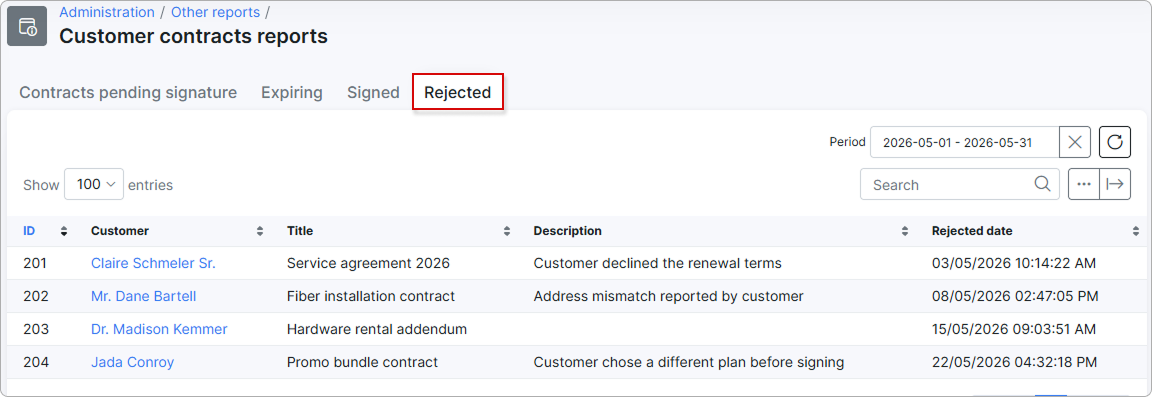
Use this tab to follow up on cancelled contracts and to measure how often customers reject the contracts you send.
¶ How values are calculated
This section explains where each tab-specific date comes from and how the filtering decides whether a contract appears in a tab.
¶ End of term (Expiring tab)
The End of term date is not stored on the contract — it is calculated each time the report runs:
- Start with the contract's start date (the date entered when the contract was generated).
- Add the contract's term length, in months.
- The result is the end-of-term date displayed in the table.
A contract is included in the Expiring tab when the calculated end-of-term date falls inside the selected period.
The yellow Expired badge is shown when that calculated date is already in the past relative to today's date. The badge is purely a visual marker on this report — it does not affect filtering.
Contracts that have no start date or no term length cannot have an end-of-term date and do not appear in the Expiring tab.
¶ Signature date (Signed tab)
The signature date is the timestamp written when the customer finishes the signing flow and the signed PDF is saved on their profile. A contract is included in the Signed tab when its signature date falls inside the selected period.
¶ Rejected date (Rejected tab)
The rejected date is the timestamp written when a contract's status changes to Rejected (for example, when the customer declines to sign). A contract is included in the Rejected tab when its rejected date falls inside the selected period.
¶ Pending signature (no calculation)
The Pending tab simply lists every contract that does not yet have a signature date — there is no period filter and no date calculation. The Date column shown on this tab is the contract's creation date.
¶ Filter by period
The Expiring, Signed, and Rejected tabs share the same period control at the top of the report. To change the period:
- Click the Period field.
- Pick a preset (Today, Yesterday, Last 7 days, This month, Last month, etc.) or choose custom start and end dates.
- Click
Apply.
The default for all three tabs is This month. The Pending tab has no period filter — it always shows the full backlog.
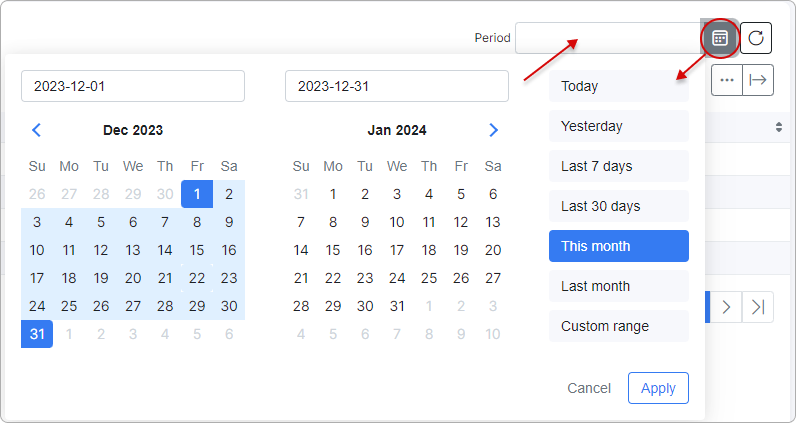
Use the refresh icon next to the period to re-run the active tab without changing any filters.
¶ Table management
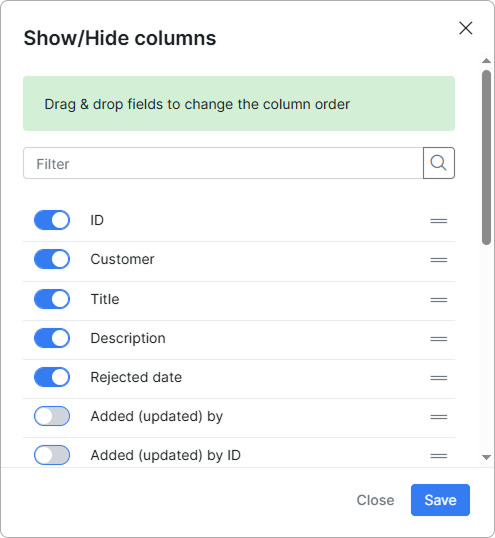
The columns shown in each tab can be customized. Click the Show/hide columns icon  above the table to toggle individual columns on or off, and drag column headers to change their order:
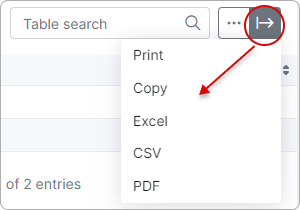
To save the current view, use the Export to icon. The report exports the rows currently filtered by the period and the search box, in any of the available formats (Print, Copy, Excel, CSV, PDF):
Use the search box above the table to filter the rows by title or description.
¶ Important notes
- The report only includes documents created as sign contracts. Plain uploaded files and ordinary generated documents (without the Sign contract option) are not shown.
- The Expiring tab is a date calculation, not a status. A contract appears there as soon as its calculated end-of-term falls inside the period — even before Splynx's background process has updated the document's stored status to Expired.
- There is no dedicated Expired tab. To find expired contracts, open the Expiring tab and look for the yellow Expired badge.
- Each tab is hard-coded to its own slice of the contract list (unsigned / expiring / signed-in-period / rejected-in-period). The tabs are not status filters you can combine — to look at a different slice (for example, all contracts that have been sent but not yet signed), use the Customers → Documents list with its own filters instead.
- The search box on each tab searches the contract's Title and Description columns.