¶ Financial reports
- Overview
- Common filters
- Show vs Generate
- Future charges
- Daily receipt
- Charge history
- Export and table management
- Important notes
- Related pages
¶ Overview
The Financial reports section, located at Administration → Other reports → Financial reports, bundles three independent reports on a single page.

Each report has its own filters, table, and export, but together they give a full view of money moving in and out of the system:
- Future charges — what every recurring customer will be billed on each day in the selected period (a forecast).
- Daily receipt — every payment that has been received in the selected period, plus a per-administrator collection summary.
- Charge history — the actual automatic charges that have already happened in the selected period.
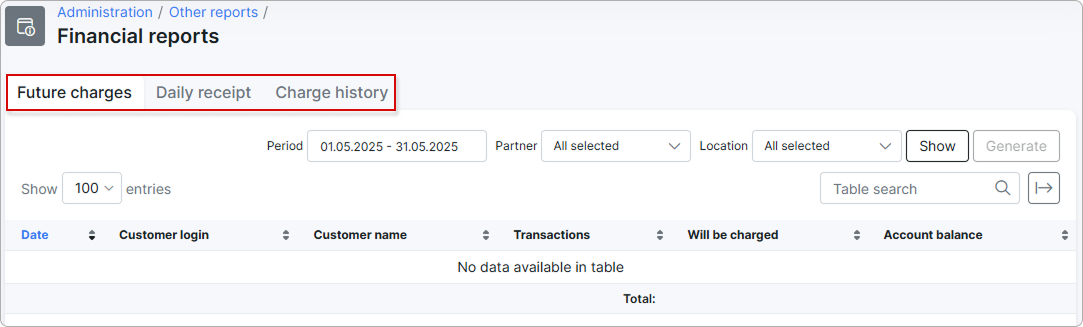
Access is restricted to super-administrators. If your administrator account is bound to a single partner, every report on this page is automatically scoped to that partner regardless of the Partner filter selection.
¶ Common filters
Three filters apply to every tab:
- Period — the date range covered by the report. Default: the current month (from the 1st to the last day).
- Partner — multi-select. Default: All selected. Limits the report to customers belonging to the chosen partners.
- Location — multi-select. Default: All selected. Limits the report to customers belonging to the chosen locations.
The Daily receipt tab adds a fourth filter — see the Daily receipt section below.

¶ Show vs Generate
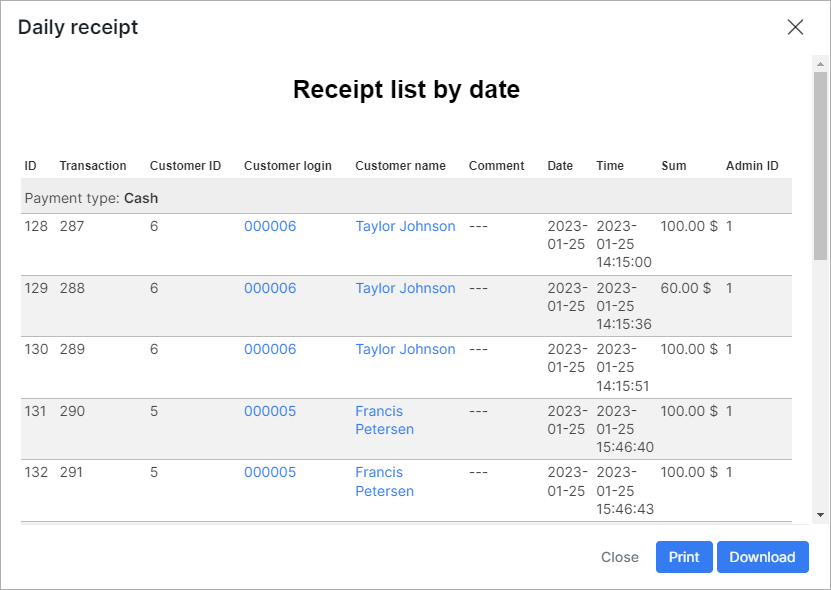
Each tab has two action buttons in the filter bar:
Show— runs the report as a background task and displays the result in the on-page table. Use this for browsing, sorting, and filtering on screen. Generating large reports may take a few seconds while the task processes.Generate— becomes available afterShowproduces a result. It opens the same data in a print-friendly HTML view (each tab has its own template), which you can then print or download as an HTML file.Generatedoes not re-query the database — it reuses the result from the lastShow.
¶ Future charges
¶ What it shows
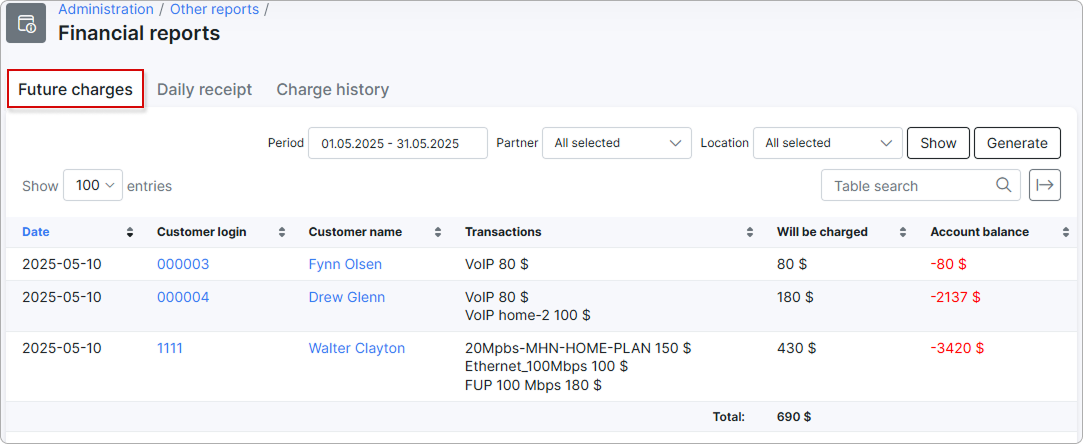
A forecast of what each recurring customer will be charged automatically on each day in the selected period — before the charge actually happens. Use this report to:
- predict cash-in for the upcoming billing cycle, and
- spot customers whose Account balance will drop below their configured minimum balance after the next charge.
¶ Columns
| Column | Description |
|---|---|
| Date | The day on which the customer is scheduled to be billed automatically. |
| Customer login | The customer's login. |
| Customer name | The customer's full name. |
| Transactions | A per-line breakdown of every transaction the system would create for this customer on this date — service charges, prorations, discounts, and taxes. |
| Will be charged | The net amount the customer will be billed on this date (see calculation below). |
| Account balance | The customer's current account balance (a negative value means the customer owes money). The cell is highlighted red when the balance after the projected charge would fall below the customer's configured minimum balance. |
A Total footer row sums Will be charged across every row in the period.
¶ How values are calculated
For each day in the selected period:
- The report finds recurring customers (customers whose billing type is Recurring) whose next billing date matches that day, filtered by Partner and Location.
- For every candidate, the report walks all the customer's active services — Internet, Voice, Recurring, Bundle, and One-Time — and simulates the same logic the auto-charge job uses on a real billing day. Proration, discounts, and taxes are applied exactly as they would be in production.
- The simulated transactions are listed in the Transactions column.
- Will be charged = sum of debit transactions − sum of credit transactions for that customer on that date.
- Account balance is the customer's current balance, taken at the moment the report runs. If
current balance − will_be_charged < customer's minimum balance, the cell is highlighted in red.
Linked Accounts in Aggregated billing mode are skipped on the sub-account side, because their charges roll up into the main account and would otherwise be double-counted.
Only recurring customers appear in this report. Prepaid customers are not in scope, because they top up their accounts manually rather than being charged on a schedule.
¶ Daily receipt
¶ What it shows
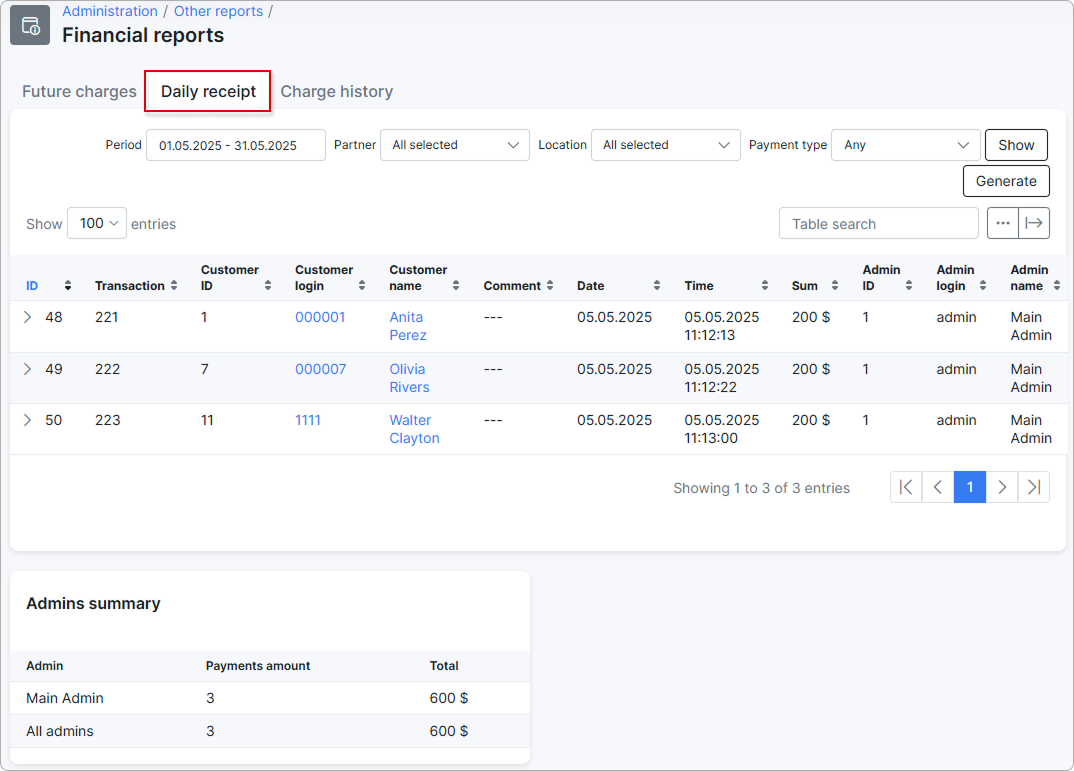
Every payment received in the selected period, plus a per-administrator summary of who collected how much. Use this report for end-of-day cash reconciliation and for measuring administrator collection activity.
¶ Extra filter — Payment type
In addition to the common filters, Daily receipt includes a Payment type dropdown. Default: Any. Available values depend on the payment methods enabled in your Splynx instance — typical values include Cash, Bank transfer, Credit card, PayPal, Other, and the names of any installed payment gateway add-ons (for example, QuickBooks, SageOne, Netcash Pay Now).
¶ Columns
The main table lists every payment that matches the filters. The default visible columns are:
| Column | Description |
|---|---|
| ID | The internal payment record ID. |
| Transaction | The matching transaction ID (if the payment is linked to a specific transaction). |
| Customer ID | The customer's internal ID. |
| Customer login | The customer's login. |
| Customer name | The customer's full name. |
| Comment | The comment entered with the payment. |
| Date | The business date assigned to the payment. |
| Time | The exact time the payment was entered into the system (not the business date). |
| Sum | The payment amount. |
| Admin ID | The internal ID of the administrator who entered the payment. |
| Admin login | The login of the administrator who entered the payment. |
| Admin name | The full name of the administrator who entered the payment. |
| Payment type | The payment method (cash, gateway-specific value, etc.). |
| Invoice | The invoice the payment was applied to, if any. |
| Invoice number | The number of the linked invoice, if any. |
| Sent? | Whether the payment notification was sent. |
| Memo | The memo recorded with the payment. |
| Note | The note recorded with the payment. |
| Receipt Number | The receipt number generated for this payment. |
| Proforma Invoice | The proforma invoice number, if applicable. |
| #1 – #5 | Custom payment fields (numbered 1 through 5). |
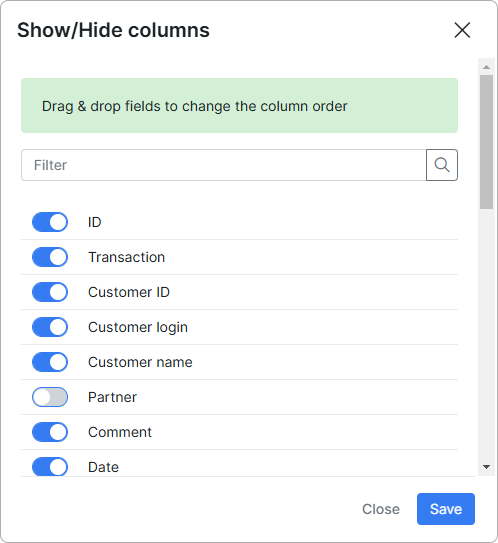
Additional columns are available but hidden by default: Partner, Credit note, Credit note number, Remind amount, and Void. Use the Show/Hide columns button above the table to toggle them on and to drag-reorder columns.
¶ Admins summary
Below the main table, the Admins summary block groups the same payments by the administrator who entered them.
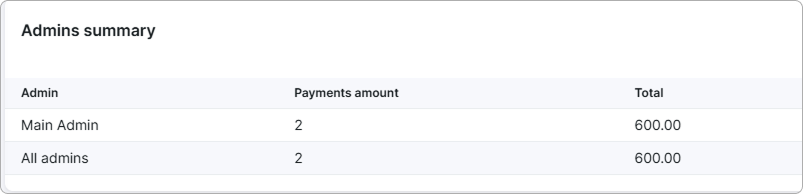
| Column | Description |
|---|---|
| Admin | The administrator's login or full name. |
| Payments amount | The number of payment records this administrator entered in the selected period. |
| Total | The sum of all payment amounts this administrator entered in the selected period. |
A final All admins row shows the totals across every administrator.
Only payments that were added by an administrator are counted in the Admins summary. Payments imported from a payment gateway, made by a customer through the Customer portal, or created by automatic imports are still listed in the main table but do not appear in the Admins summary — because no administrator added them.
¶ How values are calculated
- The report selects every payment whose date falls in the selected period and whose customer matches the Partner, Location, and Payment type filters.
- Deleted payments are excluded.
- The main table lists every matching payment as one row.
- For the Admins summary, payments are grouped by the administrator who created them: Payments amount is the count of records, Total is the sum of their amounts.
The Time column reflects the moment the payment was actually entered into Splynx, not the business Date assigned to the payment. The two can differ when an administrator backdates a payment.
¶ Charge history
¶ What it shows
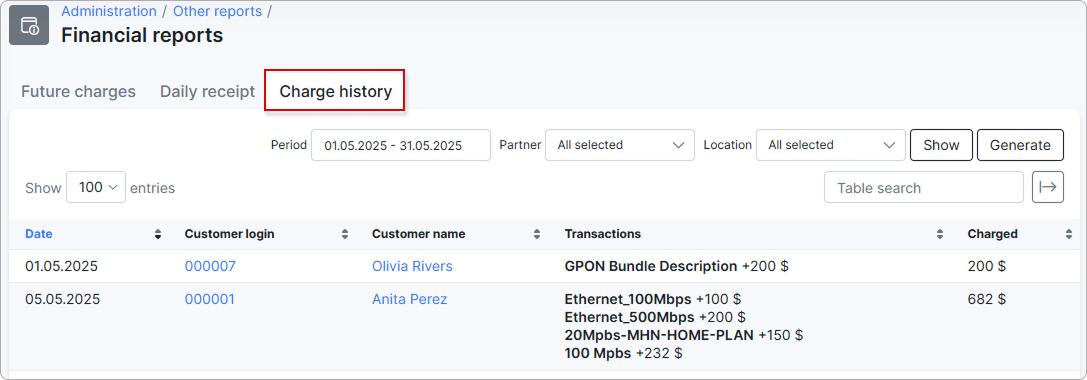
The actual automatic charges that have already been applied in the selected period — the historical counterpart to Future charges. One row per (customer, date) pair, with all of that day's automatic transactions rolled up.
¶ Columns
| Column | Description |
|---|---|
| Date | The date the automatic charge was applied. |
| Customer login | The customer's login. |
| Customer name | The customer's full name. |
| Transactions | Every transaction created on this date for this customer, listed with its description and signed amount: debits as +amount, credits as -amount. |
| Charged | The net amount charged on this date (see calculation below). |
¶ How values are calculated
- The report finds recurring customers matching Partner and Location.
- For each customer, it pulls their automatic transactions whose date falls in the selected period. Automatic means transactions created by the auto-charge job — manually added invoices, manual transactions, and one-off adjustments are not included.
- Transactions are grouped by customer + date — one row per pair.
- Charged = Σ debits − Σ credits for that customer on that date.
A grand total across every row is computed as well, used by the printable export.
A customer with only credit or refund automatic transactions on a given date will show a negative value in the Charged column.
Only auto-generated transactions appear here. This report is designed to show what the billing engine charged on its own — manual invoices and manual adjustments are intentionally excluded.
¶ Export and table management
Each report's table can be exported and customized.
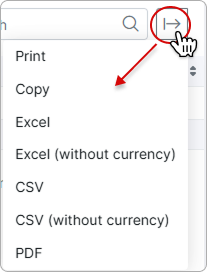
Use the export button  to print, copy, or export the table in Excel, CSV, or PDF format. Excel and CSV options are available with or without currency values.
Use the Show/Hide columns button  to enable or disable individual columns and to drag-reorder them.
¶ Important notes
- Future charges is a projection. The actual charges may differ from the forecast if services, discounts, taxes, or billing settings change before the real billing date.
- Daily receipt time stamps reflect when each payment was entered into Splynx, not the business date assigned to the payment. Backdated payments will appear under their Date but with their original entry Time.
- Charge history intentionally ignores manual transactions. To audit manual adjustments and one-off invoices, use the customer's transaction history or the Account statements report.
- All three tabs run as background tasks. After clicking
Show, the table is populated when the task finishes — large date ranges or large customer bases will take longer. - The
Generatebutton reuses the lastShowresult; it does not re-run the report.