¶ Inventory reports
- Overview
- Stock location access
- Sold & rented items
- Items history
- How values are calculated
- Filtering and refreshing
- Table management
- Important notes
- Related pages
¶ Overview
The Inventory reports page brings together two views of how inventory items move through Splynx:
- Sold & rented items — a financial summary of items that were sold, given to customers without an invoice, or rented out during a selected period, with Total price and Total cost price at the bottom.
- Items history — a chronological audit trail of every status change an inventory item went through during the period, with the administrator who made each change.
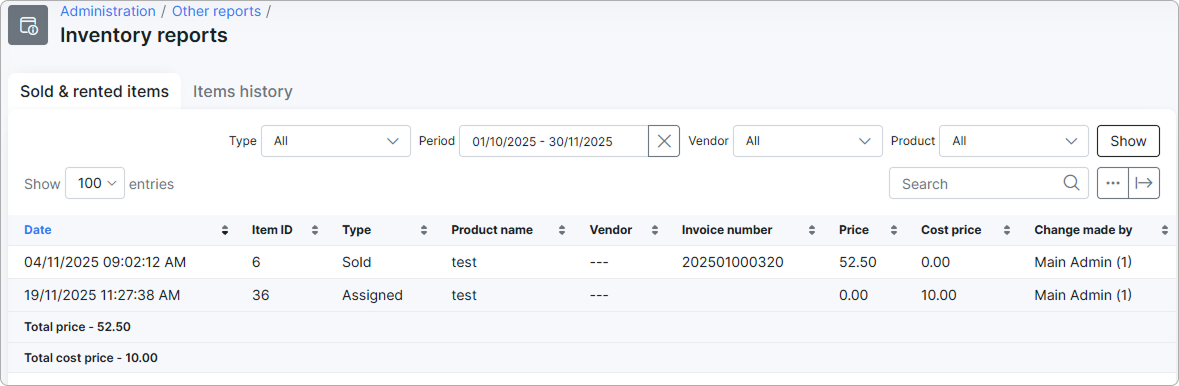
Use this page to answer two routine questions: How much did we earn (and at what cost) on inventory this month? and What exactly happened to a specific item, and who changed it?
To open the report, go to Administration → Other reports → Inventory reports.

Access depends on the administrator's role:
- The Sold & rented items tab is available only to Super-administrator and Administrator roles.
- The Items history tab is available to Super-administrator, Administrator, Manager, and Financial manager roles.
An administrator who has neither tab cannot open the page at all.
¶ Stock location access
Both tabs respect the stock locations assigned to your administrator role. You only see records for items stored in stock locations you are allowed to access — items in other stocks are excluded from the rows and from the totals.
Stock access is configured per role on Config → Inventory → Stock locations. If a colleague sees rows you don't, it usually means their role has access to additional stock locations.
¶ Sold & rented items
What it answers: during the selected period, which inventory items left the warehouse — sold, assigned to a customer without an invoice, or rented — and what is the financial result.
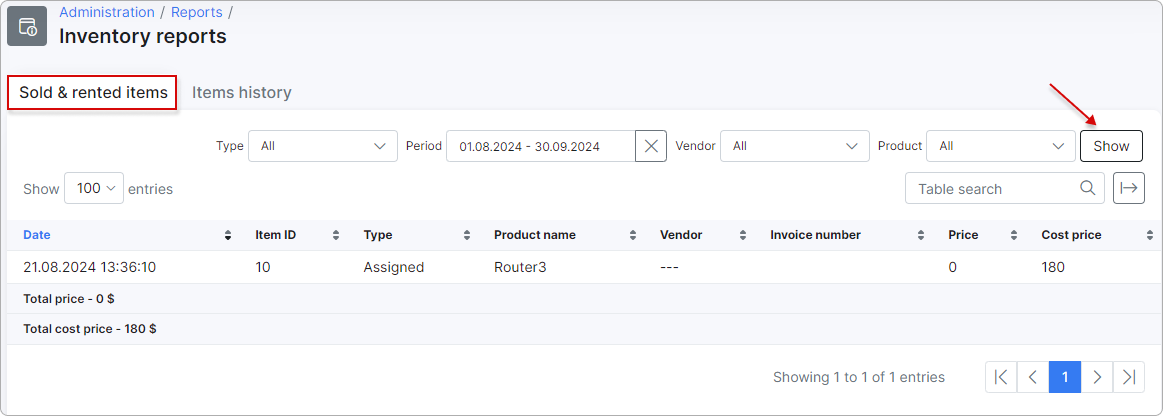
¶ Filters

- Type — limits the report to one of four slices:
- All (default) — sold, assigned without invoice, and rented items, all together.
- With invoice — items finalized with a sales invoice.
- Without invoice (assigned) — items handed over to a customer without billing.
- Rent — items currently rented out to a customer.
- Period — date range. Defaults to This month (first day to last day of the current month). The report picks each item's most recent matching status-change inside this period.
- Vendor — filter by the vendor configured on the inventory product.
- Product — filter by a specific inventory product. The dropdown narrows itself to products of the chosen vendor.
Click Show to run the report.
¶ Columns
| Column | Description |
|---|---|
| Date | The date and time when the item changed status (sold, assigned, or rented). |
| Item ID | The internal identifier of the inventory item. |
| Type | The item's resulting status — Sold, Assigned, or Rent. Hidden when you filter by a specific Type, because every row has the same value. |
| Product name | The inventory product the item belongs to. |
| Vendor | The vendor configured on the product. |
| Invoice number | The sales invoice the item was billed on. Shown only for the With invoice type. |
| Price | The sale or rental price for this item — see How values are calculated for the full rules. Empty in Without invoice mode. |
| Cost price | The purchase price stored on the item, usually copied from the supplier invoice when the item was received. |
| Change made by | The administrator who recorded the status change. Empty if no matching entry exists in the admin operations log (for example, when the period is older than the admin-log retention horizon, or the change was made automatically by Splynx). |
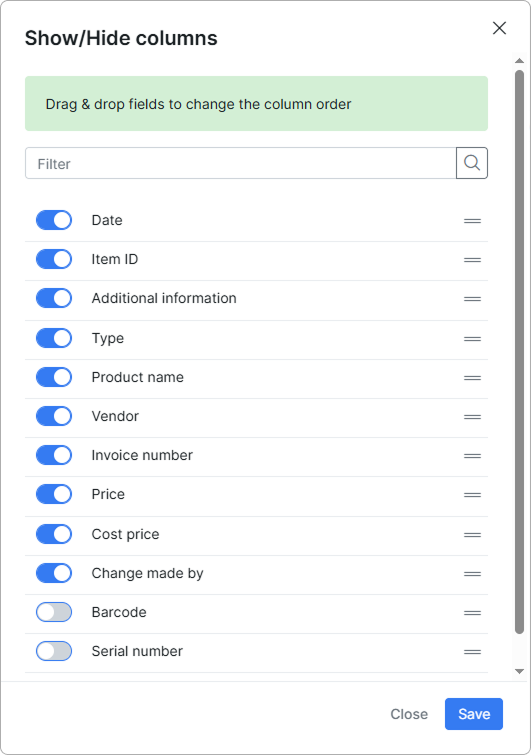
| Barcode | The item's barcode. Hidden by default — enable it from Show/hide columns. |
| Serial number | The item's serial number. Hidden by default — enable it from Show/hide columns. |

The footer of the table shows two totals:
- Total price — the sum of the Price column over the rows actually displayed.
- Total cost price — the sum of the Cost price column over the same rows.
Both totals are calculated only on the rows you currently see — changing filters changes the totals. Values use the partner's display currency and number formatting.
¶ How rows are picked
The report walks through every status change recorded for an item during the period in chronological order, then keeps only the latest matching status the item had inside the period. This means:
- If an item moved stock → sold on the 5th, it appears in the period as Sold on the 5th.
- If the same item moved sold → returned on the 20th of the same period, it disappears from the report — its final status in the period no longer matches the Type filter.
- Each item can appear at most once in the Sold & rented items tab for a given period.
The shown Date is the moment the status change was recorded on the item, not the invoice or transaction date. A sold item appears under the date when it was marked Sold, even if the invoice was issued on another day.
¶ Items history
What it answers: what happened to each inventory item during the selected period — every status change, the date and time of each change, and the administrator who made it.
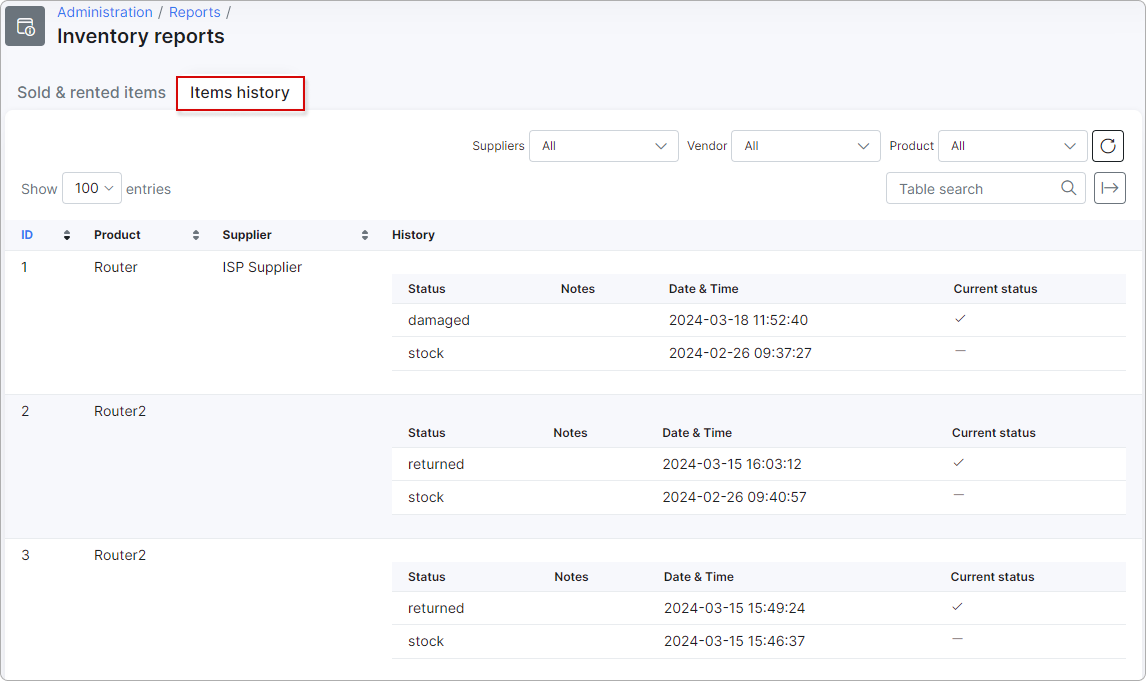
¶ Filters

- Suppliers — filter by the supplier of the supplier invoice the item was received under.
- Vendor — filter by the vendor configured on the inventory product.
- Product — filter by a specific inventory product. The dropdown narrows itself to products of the chosen vendor.
- Period — date range. Defaults to This month.
This tab runs immediately — there is no Show button. Changing any filter refreshes the table.
¶ Row structure
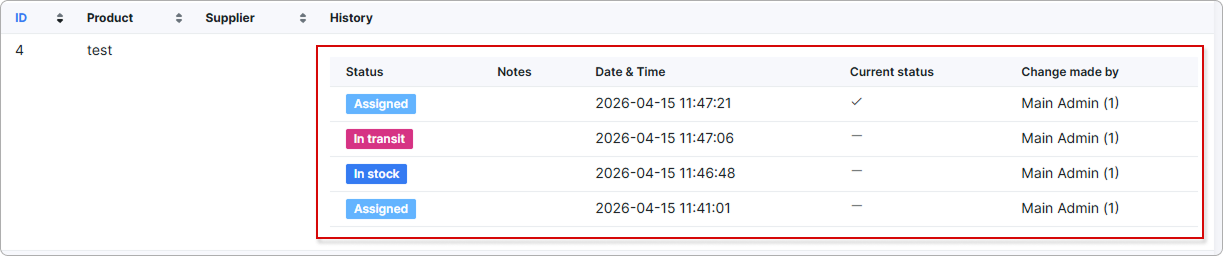
Rows are grouped by inventory item. Every item that had at least one status change inside the period appears once in the outer table. The outer columns are:
| Outer column | Description |
|---|---|
| ID | The internal identifier of the inventory item. |
| Product | The inventory product the item belongs to. |
| Supplier | The supplier of the supplier invoice the item was originally received on. |
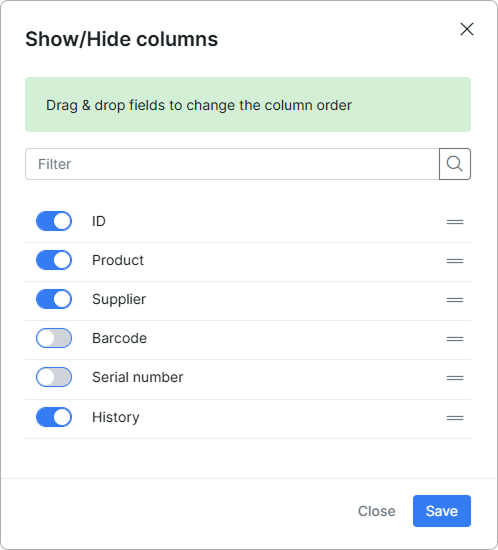
| Barcode | The item's barcode. Hidden by default. |
| Serial number | The item's serial number. Hidden by default. |
| History | A nested sub-table listing every status change for this item in the period. |
The nested History sub-table has one row per status change, ordered by date and time descending. Its columns are:
| History column | Description |
|---|---|
| Status | The status the item moved into, rendered as a colored badge: In stock, Sold, Rent, Assigned, Returned, In transit, Damaged, In task, Deployed, or Internal usage. |
| Notes | Free-text notes recorded with the status change (if any). |
| Date & Time | When the status change was recorded. |
| Current status | The item's status right now (the same value repeats on every history row of the item). |
| Change made by | The administrator who recorded the change, shown as Name (ID). Empty when no matching admin-log entry exists — for example, when the period is older than the admin-log retention horizon, or when the change was made automatically by Splynx. |
Records of items that were later deleted are not included.
¶ How values are calculated
This section spells out how the report decides what to put in each calculated field.
¶ Price (Sold & rented items tab)
The Price column is resolved in the following order. The first rule that matches wins:
- Transaction match. If a financial transaction is linked to this item's status change — either directly or through the matching sales invoice and product — and the transaction's date equals the item's status-change date, the price is
transaction total ÷ transaction quantity. This is the unit price actually charged on the financial transaction. - Sold without a transaction. If the item's status is Sold but no matching transaction is found, the price is the product's catalogue sale price (configured on the inventory product itself).
- Rent. For rented items, the price is
service unit price × service quantityof the linked customer service. If recurring transactions exist for that service inside the selected period, the price is replaced by the sum oftransaction total ÷ quantityof those transactions — so service renewals during the period are reflected. - Without invoice (assigned). The Price column is intentionally left blank, because no money changes hands when an item is assigned without billing.
¶ Total price and Total cost price (footer)
The two totals at the bottom of the Sold & rented items table are calculated on the rows currently displayed:
- Total price = sum of the Price column across all displayed rows.
- Total cost price = sum of the Cost price column across all displayed rows.
They are recalculated whenever the filters change. They are not warehouse-wide aggregates — they only cover what your filters selected.
¶ Cost price (both tabs)
The Cost price value is the purchase price stored on the inventory item itself, typically populated from the supplier invoice when the item was received into stock. It does not change when the item is later sold, rented, or assigned — it always reflects what the item cost the company.
¶ Change made by (both tabs)
The Change made by column is resolved by looking up the admin operations log for an edit/create action on the inventory item, dated inside the selected period, matched to the status-change record by item ID, resulting status, and exact timestamp.
The column is intentionally left empty when no matching log entry exists. The most common reasons are:
- The period is older than Splynx's admin-log retention horizon (controlled by the admin-log rotation setting).
- The status change was made automatically by Splynx (for example, by a background job), so no admin acted on it.
¶ Column visibility (Sold & rented items tab)
Two columns appear or disappear automatically based on the active filters:
- Type — visible when Type = All, hidden when you pick a specific type (since every row would carry the same value).
- Invoice number and Price — hidden when Type = Without invoice (assigned), since those rows never have an invoice or a price.
¶ Filtering and refreshing
The Sold & rented items tab runs asynchronously to handle large date ranges without freezing the page:
- Adjust the filters and click
Show. - The report runs in the background. The page checks the status every few seconds and fills the table when the result is ready.
- While the report is running, you can keep using other parts of Splynx — the table updates on its own when the data arrives.
The Items history tab runs synchronously — there is no Show button, and the table refreshes as soon as you change a filter.
¶ Table management
To customize what each table shows, use the buttons in the top-right corner above the table:
- Show/hide columns — toggle individual columns on or off, and drag column headers to change the order. Hidden by default in both tabs: Barcode and Serial number.
Sold & rented items:
Items history:
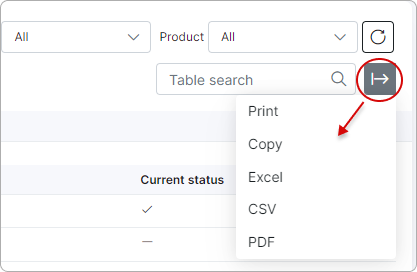
- Export to — export the currently filtered rows. Available formats: Print, Copy, Excel, CSV, and PDF.
The search box above the table filters rows by their text content.
¶ Important notes
- The report has no chart — both tabs are tabular only. If you need a chart of sales or movements over time, export the table and chart the data externally.
- Date in the Sold & rented items tab is the moment the status change was recorded on the item, not the invoice or transaction date.
- One item can appear at most once in the Sold & rented items tab for a given period — only its latest matching status inside the period is kept. If an item was sold and then returned within the same range, it does not appear.
- Footer totals on the Sold & rented items tab reflect the filtered rows, not the whole warehouse. Changing filters changes the totals.
- The Items history tab excludes items that have been deleted from Splynx.
- The stock-location filter is invisible on the page but always active. Differences in what two administrators see usually come from different stock-location permissions on their roles.