¶ List
¶ All customers
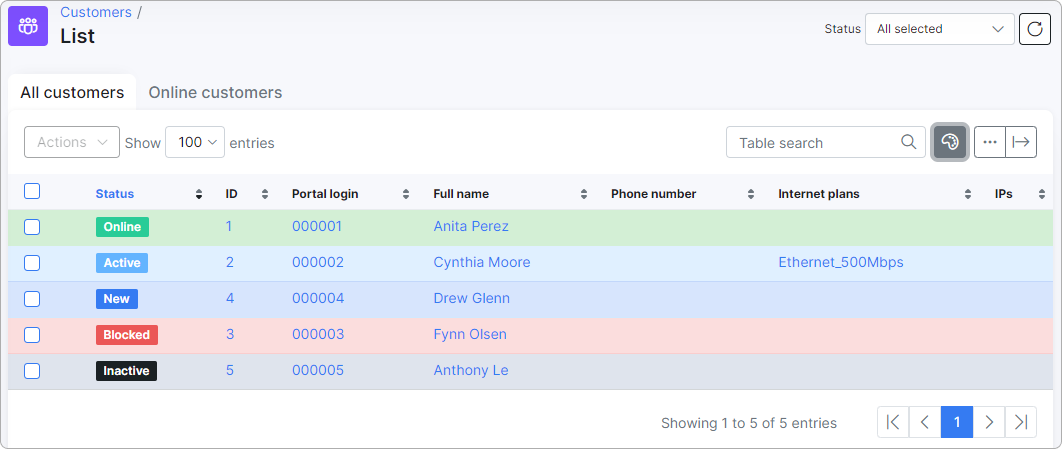
Under the All customers tab, you can view a table containing information about all your customers, including their respective statuses and additional details such as Portal login, phone number, IPs, etc.
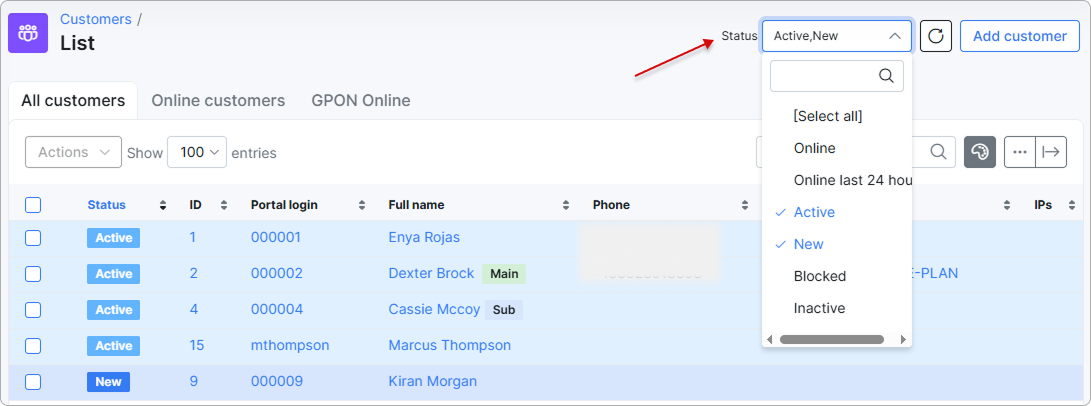
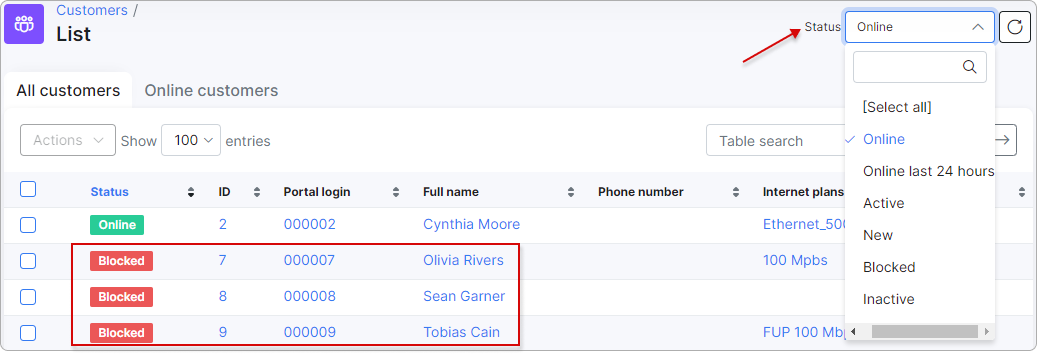
You can use the Status filter to filter customers in the table according to their current statuses:
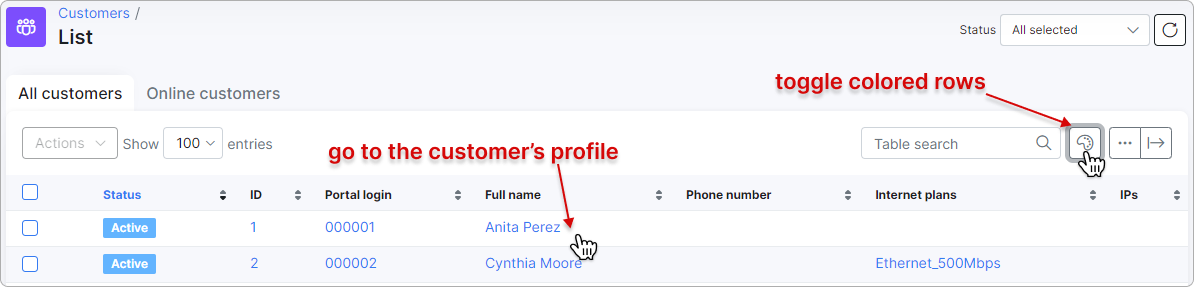
To access the customer's profile, click on the row corresponding to the respective customer—whether it's their name, portal login, or ID. Utilize the color palette button to toggle colored rows according to status.
Click the tariff plan name to view its details:
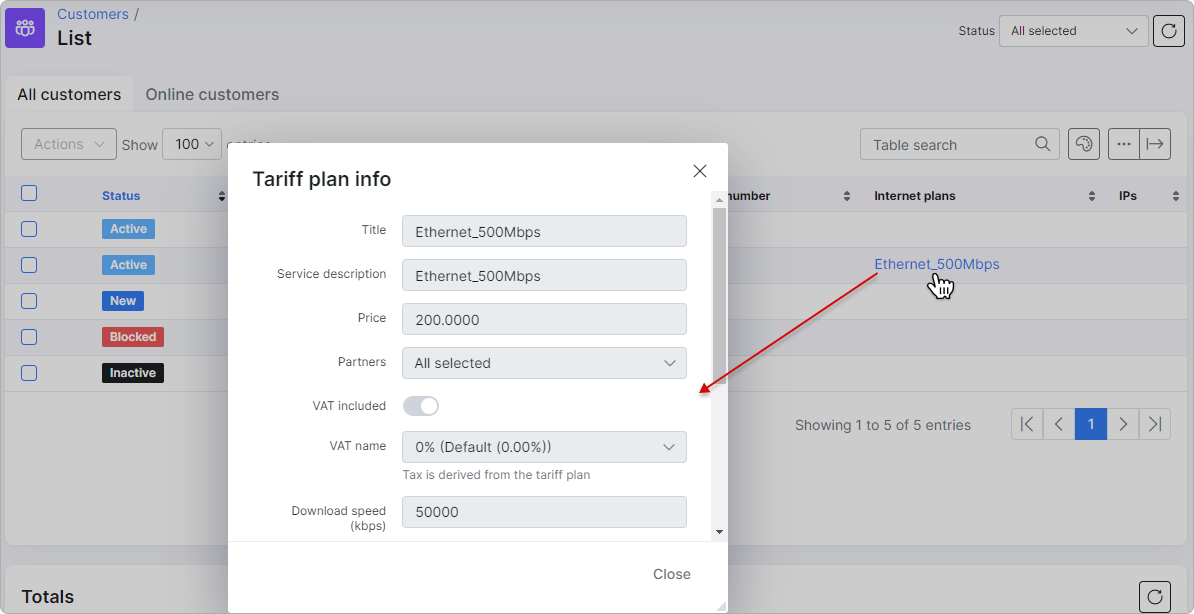
To learn more, please read
Modifying the customer table
¶ Mass actions
Select one or more customers in the All customers table (use the row checkboxes or Select all), then open the Actions drop-down at the top of the table. Each action shows a badge with the number of selected rows it will apply to.
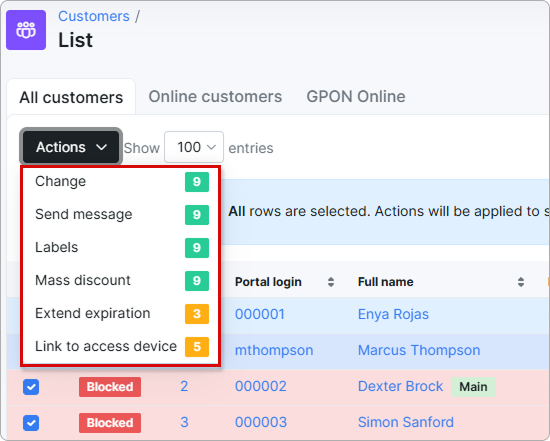
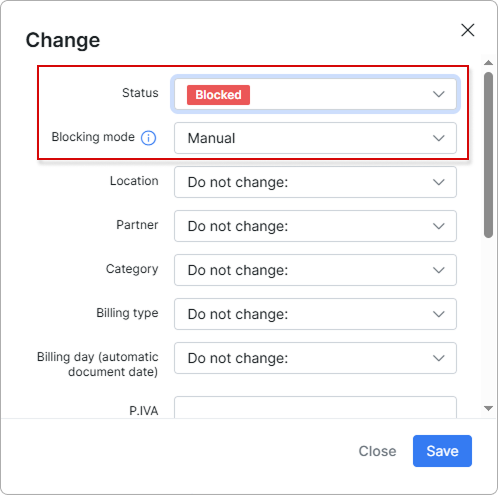
- Change — bulk-edit selected customers (status, partner, location, billing parameters, etc.).
When you set Status to Blocked, a Blocking mode field appears right below it: pick Manual to record the block as made by an administrator, or Auto to record it the way Splynx marks customers blocked for an unpaid invoice or an expired service. The mode applies to every selected customer and is shown in brackets next to their Blocked status — see Blocked: Auto or Manual. Every other field keeps its Do not change: value unless you set it, so you can change the status and the blocking mode without touching partner, location or billing parameters. Click
Saveto apply, orCloseto leave the customers untouched.
- Send message — send an email or SMS to every selected customer. When Send to is set to Email (or Customer portal & email), the form shows a Send from picker for choosing the outgoing mailbox the campaign goes out from. Options follow the
{Sender email} ({Category})format; only mailboxes available to the current admin (and the customer's partner where applicable) that are enabled in Outgoing mailboxes are listed. The full field list (including Notification category, Subject, Message, Templates and Attachments) is documented under Mass sending. - Labels — add or remove labels on the selected customers in a single operation.
- Mass discount — apply a discount to the selected customers' services.
- Extend expiration — push back the prepaid service expiration date for the selected customers in one operation. Only prepaid customers with active services are eligible, so the action badge usually shows a lower count than the others — non-prepaid customers and those without active services are skipped. See Extend expiration.
- Link to access device — link the selected customers to an access device. The action badge may show a lower count than the other actions — only customers with services that can be linked are eligible.
¶ Online customers
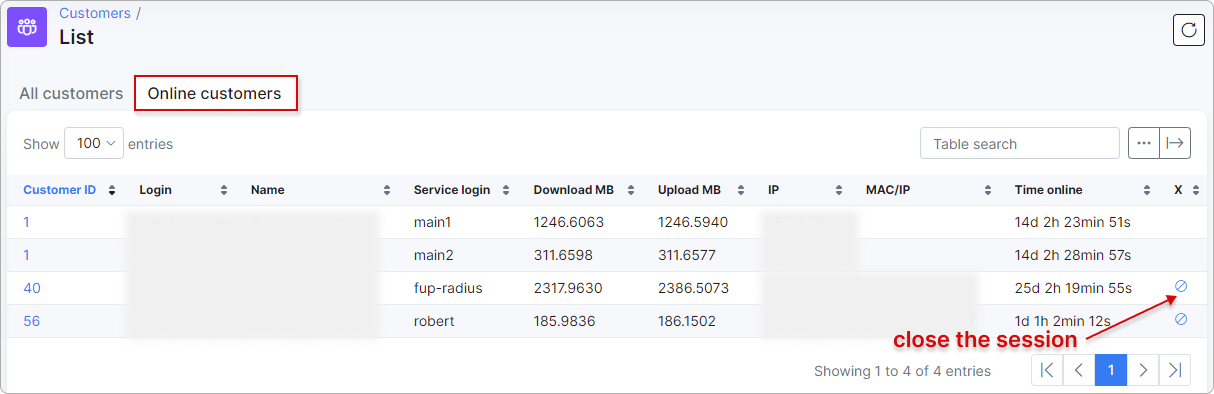
Under the Online customers tab, you will find information about customers who are currently online, including details such as Download/Upload MB, MAC/IP, Time online, etc. Additionally, you can end sessions for customers utilizing Radius authorization by clicking on the close icon:
¶ Totals
Under Totals, you will find statistics detailing the number of customers per status along with the corresponding sums for their services.

¶ Statuses
There are six statuses that customers can have: New, Active, Online, Online last 24 hours, Blocked, and Inactive.
| Status | Definition |
|---|---|
 |
The customer has recently been created or added to the system but has not yet utilized any services. |
 |
The system can take the customer's profile into account and make features available. |
 |
The customer is currently online. |
 |
The customer has been online for the past 24 hours; |
 |
The customer either failed to make payments for services or was simply denied access when taking their profile into account. |
 |
The status, triggered during the deactivation (grace) period, suspends customer services and accounting. It's assigned automatically to customers with prolonged service inactivity. You can delete profiles with this status. |
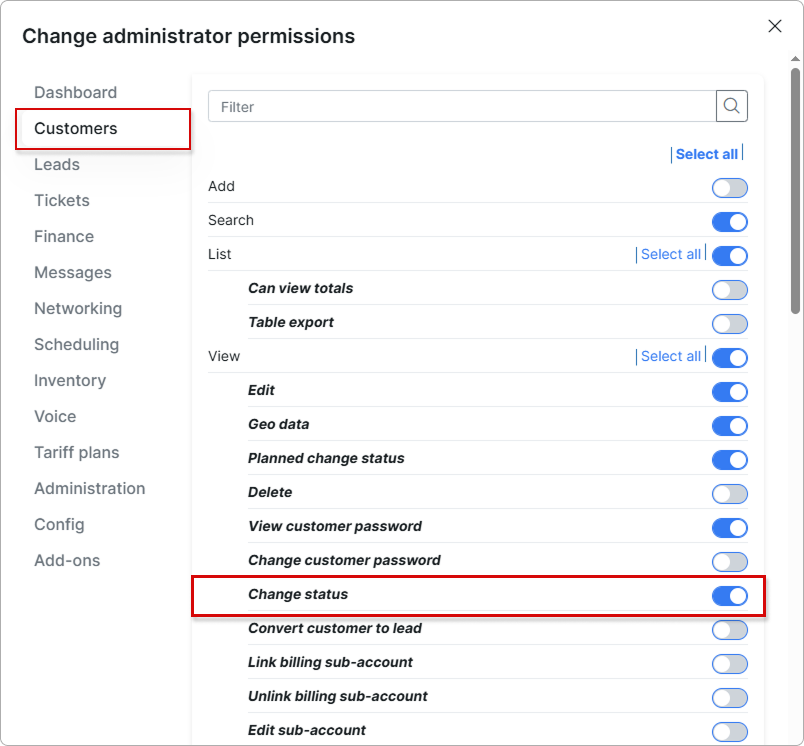
You can configure permissions for changing status in Administration → Administrators:
For more details, see Administrators and Default roles and its permissions
Blocked customers connected via RADIUS have special IPs designated for them, and they are shown in both the Online and Blocked filters. This is intentional; these customers can establish a connection, but they are restricted from using the internet. If, however, they attempt to use the internet, the statistics will reflect this, indicating a potential incorrect blocking by the provider on the router.
¶ Blocked: Auto or Manual
When the customer is blocked, the method of blocking will be indicated in brackets next to the Blocked status: automatically by the system or manually by the admin:
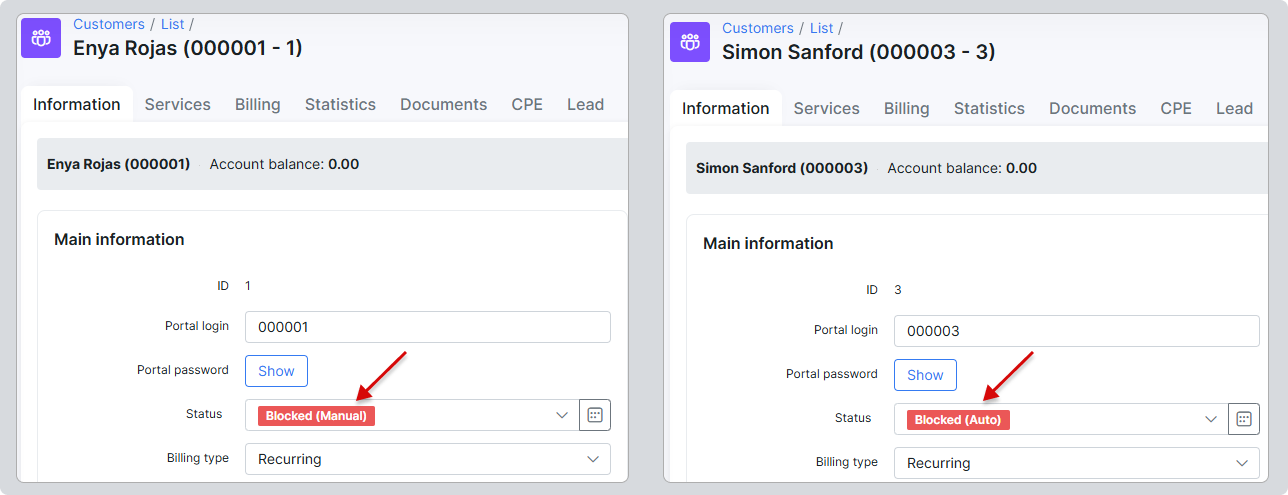
The method is no longer decided only by Splynx: when an administrator sets the status to Blocked, the Blocking mode selector asks which method to record. In the customer's profile it appears in the Change customer status window (see Customer information); in Actions → Change it appears under the Status field (see Mass actions). Blocks made by the system are always recorded as Auto.
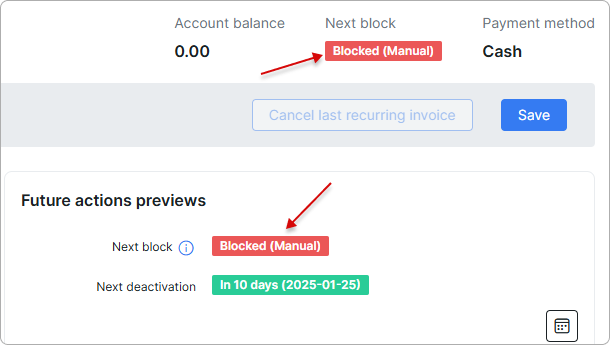
The method of blocking will also be indicated in the customer's Billing section:
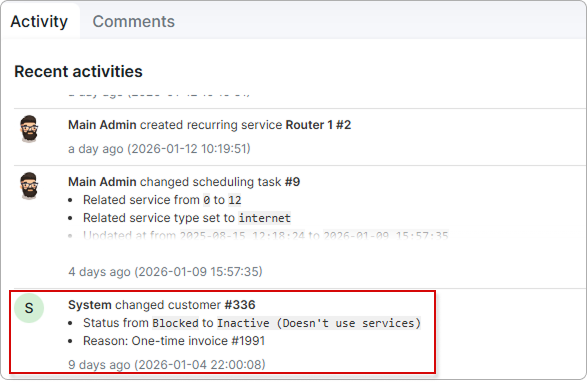
If the system blocks or deactivates a customer, the reason will be stated in the customer’s activity section: