¶ Tax summary
- Overview
- Tax report tab
- Tax total report tab
- How values are calculated
- Sign convention and rounding
- Filter scope and partner restriction
- Permissions
- Examples
- Important notes
- Related pages
¶ Overview
The Tax summary page gives you a tax breakdown of all invoiced and credited revenue for a chosen period. It is built from your finance documents — invoices add to the totals, credit notes subtract — so the numbers reconcile with the rest of the billing module.
To find the report, navigate to Administration → Featured reports → Tax summary:

The page contains two independent tabs, each with its own purpose:
- Tax report — a line-by-line listing of every taxed transaction, grouped by tax. Use it for auditing or when you need to see exactly which invoices and credit notes contributed to a tax total.
- Tax total report — an aggregated, one-row-per-tax summary. Use it for filing or exporting period totals.
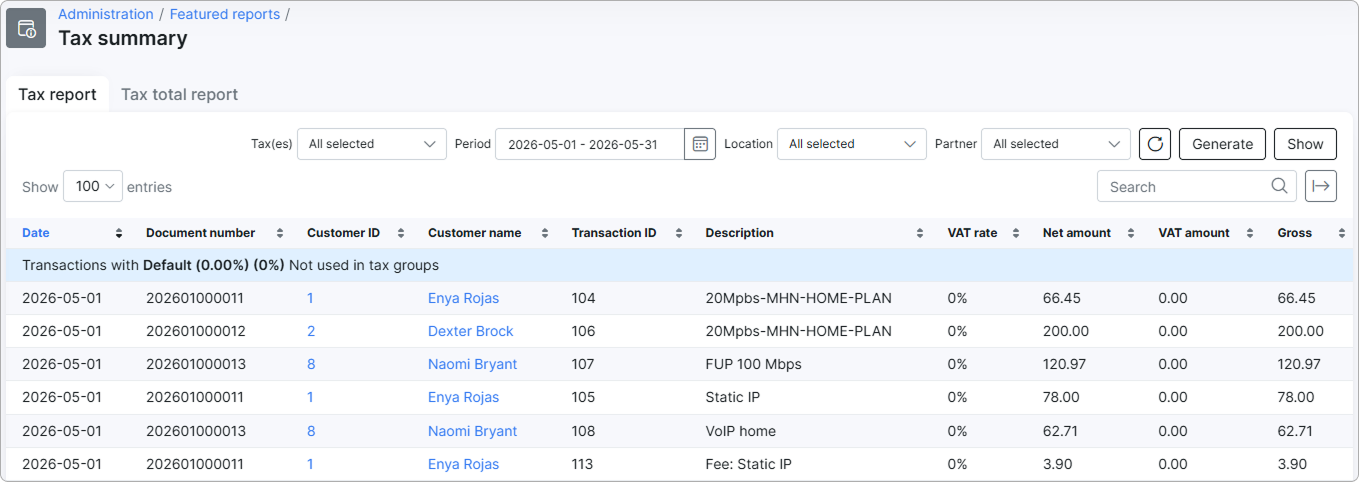
The wording VAT (or GST, or any other label) shown in column names like VAT rate or VAT amount comes from your tax name setting in Localization (the Tax name field). Adjust that setting if your country uses a different term.
¶ Tax report tab
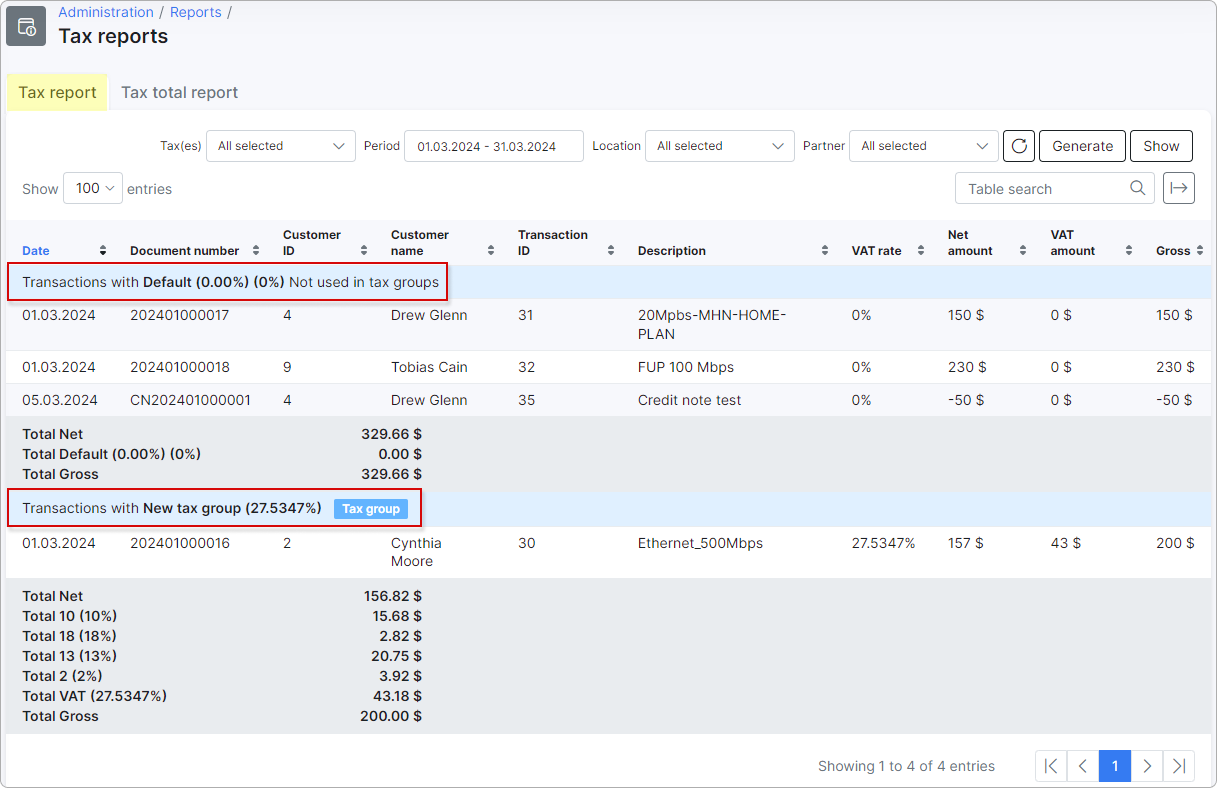
The Tax report tab lists every taxed item from every matching invoice and credit note in the selected period, grouped by the tax under which it falls.
¶ Filters
The top filter bar narrows what data is included in the table.
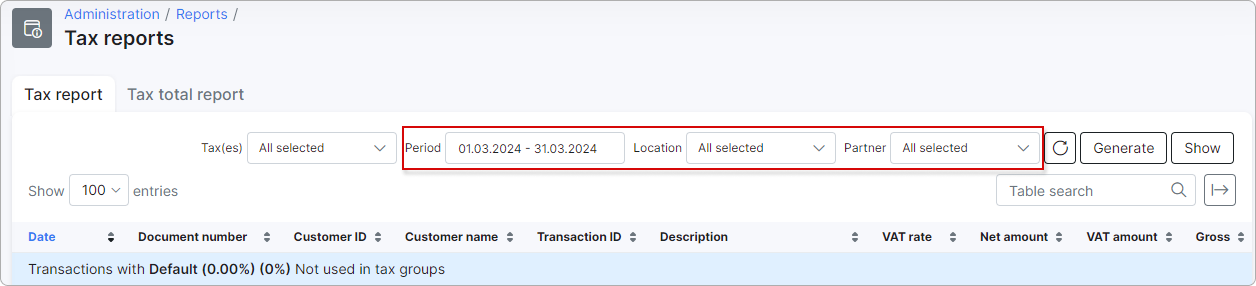
- Tax(es) — one or more individual taxes or tax groups. When you pick a single tax that also belongs to one or more tax groups, the report includes lines where the tax was applied directly and lines where it was applied as a component of a tax group.
- Period — date range, default This month (1st to last day). The report includes documents whose creation date falls between From and To.
- Location — multi-select of customer Locations.
- Partner — multi-select of Partners.
After changing the filters, click Show to refresh the table. The refresh icon next to Generate re-runs the report with the same filters without reopening the page.
¶ Columns
For every taxed line of every matching document, the table shows:
| Column | Description |
|---|---|
| Date | Creation date of the invoice or credit note that contains the line. |
| Document number | Number of the source invoice or credit note. |
| Customer ID | Splynx ID of the customer (linked to the customer card). |
| Customer name | Customer's full name (linked to the customer card). |
| Transaction ID | ID of the line item inside the document. |
| Description | The item description as written on the invoice or credit note (usually the service name). |
| VAT rate | Rate of the tax under which this line is shown. |
| Net amount | Pre-tax amount of the line. For lines taxed by a tax group, this is the part of the amount on which the current component tax was calculated. |
| VAT amount | Tax amount of the line. For lines taxed by a tax group, this is the part of the tax that came from the current component tax. |
| Gross | Net amount + VAT amount. |
The column headings VAT rate and VAT amount show whatever you set in Tax name under Localization. If your tax name is GST, you will see GST rate and GST amount.
¶ Grouping and totals
Rows are grouped by the tax they belong to. Each group has a header and a footer.
Group header — starts with Transactions with, followed by the tax name and rate, and one of the following labels:
- Tax group badge — if the section is for a tax group. The section then lists every line where that group was applied.
- Not used in tax groups — if the section is for a stand-alone tax that is not a member of any tax group.
For example: Transactions with Default (0.00%) (0%) Not used in tax groups.
Group footer — totals for the group:
- Total Net — sum of all Net amount values in the group.
- Total {component tax} ({rate}) — one line per component tax. For tax groups, there is one such line per component. For stand-alone taxes, there is exactly one line that holds the sum of the VAT amount column for the section.
- Total Gross — Total Net + the total tax amount.
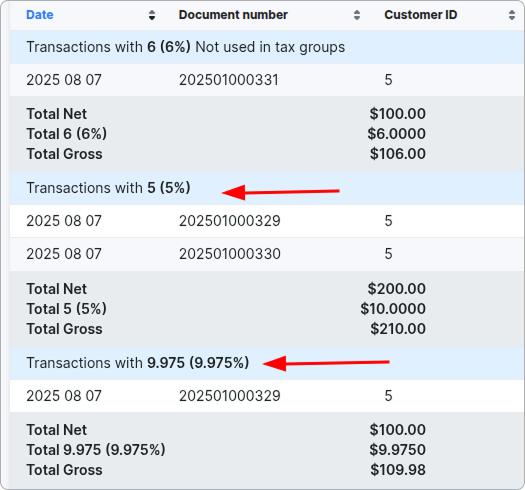
A single invoice line can appear in more than one section. If a line is taxed by a tax group, it shows up once under the group itself (with the group's combined rate) and once under each component tax (with the component's rate and the component's share of the tax). This is what lets the report show, for example, the VAT 13% portion of a VAT 13% + Eco fee group separately.
¶ Generate, print, and download
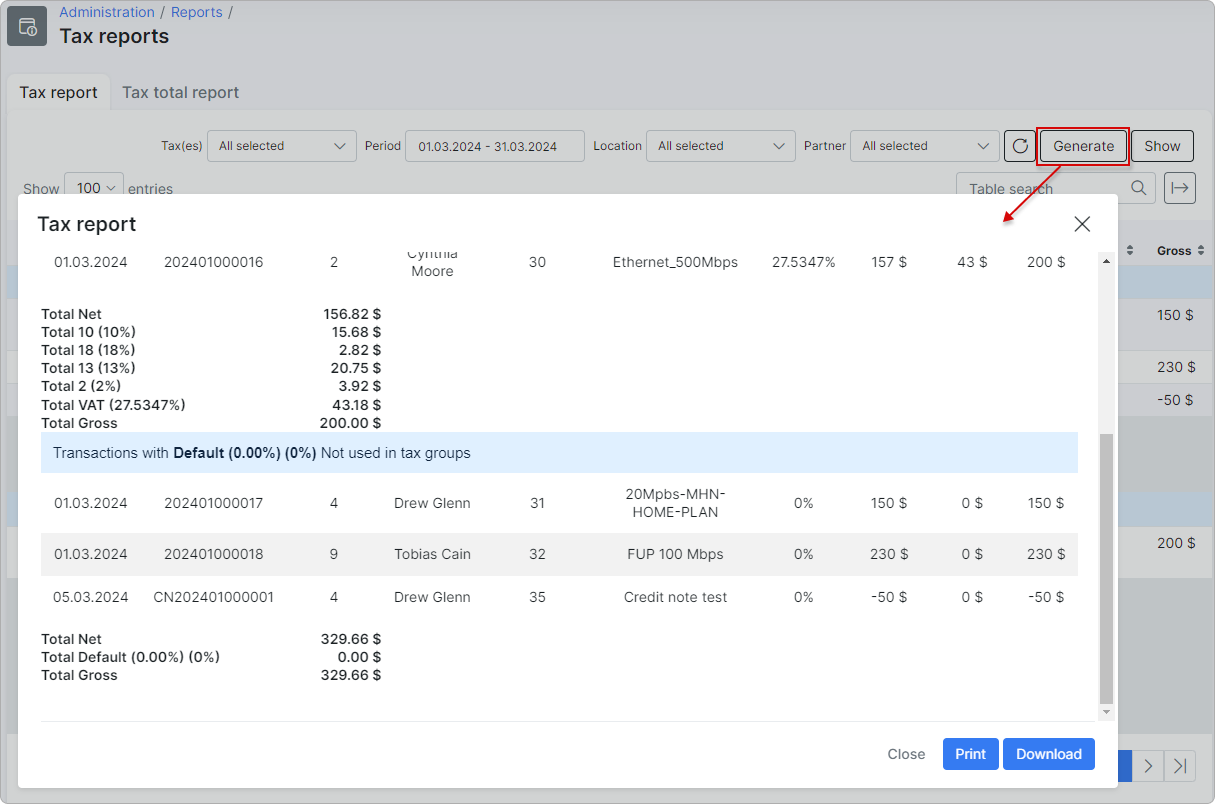
Click Generate to open the Tax report by date modal. It runs the same calculation as the table on screen but renders the result as a single printable document with the selected filters in the header (generated date, From/To, Locations, Partners, Taxes).
From the modal, you can:
- Click
Printto open the report in a new tab with full styling and trigger your browser's print dialog. - Click
Downloadto save the report as an HTML file named{from}_{to}_tax_report.html.
¶ Tax total report tab
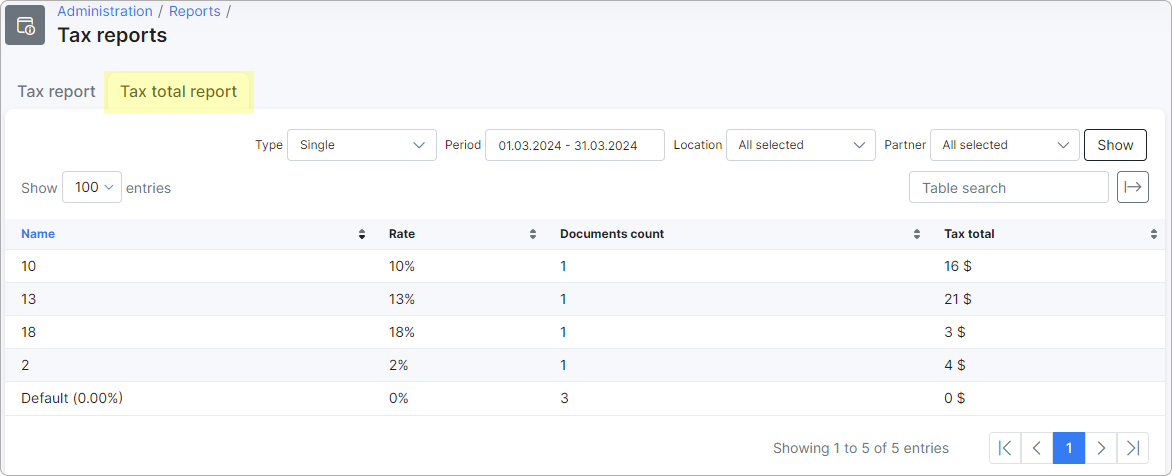
The Tax total report tab uses the same data as the Tax report tab but collapses everything into one row per tax. Use it when you need filing-ready totals rather than line-by-line detail.
¶ Type filter — Single vs Groups
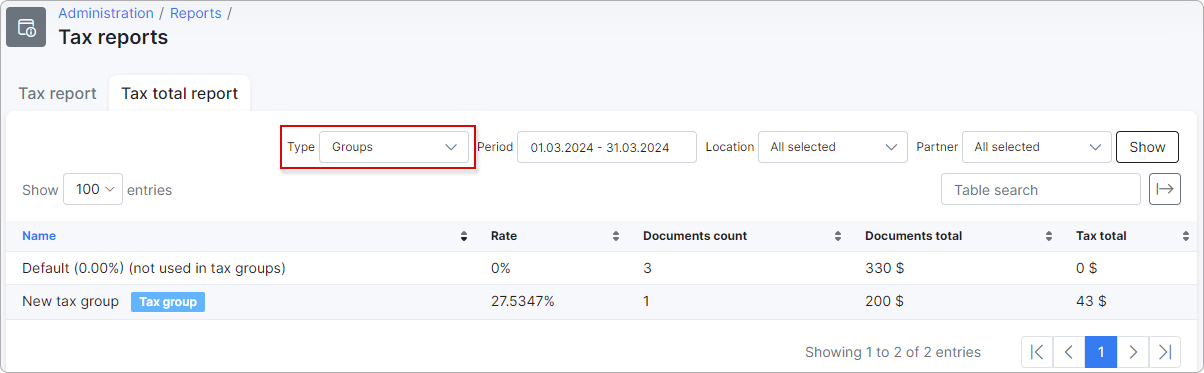
The Type dropdown is shown only when at least one tax group exists in your system. It changes how lines taxed by a tax group are aggregated:
- Single — aggregate by individual tax. A line taxed by a tax group is split between its component taxes (each component contributes its allocation), so every row represents a single tax rate.
- Groups — aggregate by the tax that was actually applied to the line. A line taxed by a tax group adds to the row for that group; a line taxed by a stand-alone tax adds to the row for that tax (marked (not used in tax groups)).
In the Groups view, the Tax total report also shows a Documents total column.
¶ Columns
| Column | Description |
|---|---|
| Name | Tax name. In Groups mode, group rows show a Tax group badge and stand-alone tax rows are marked (not used in tax groups). |
| Rate | Tax rate (%). |
| Documents count | Number of distinct invoices that contain at least one line affected by this tax, plus the number of distinct credit notes that contain at least one such line. |
| Documents total | Only in Groups mode. Sum of the gross amounts of every line taxed by this group. Invoices add, credit notes subtract. |
| Tax total | Sum of the tax amounts contributed by this tax. Invoices add, credit notes subtract. |
The Period, Location, and Partner filters work the same way as on the Tax report tab. The Tax total report tab has only the Show button — no Generate or refresh action.
¶ Background processing
The Tax total report is heavier to calculate than the line-by-line report, so Splynx runs it as a background task. After you click Show, the page checks every five seconds for the result and renders the table as soon as it is ready. The column headings update automatically when you switch between Single and Groups.
¶ How values are calculated
The Tax summary report uses your finance documents as the single source of truth. Both tabs scan the same two sources for the selected period:
- Invoice items — every line on every invoice whose creation date falls within the period. These count as positive amounts.
- Credit note items — every line on every credit note whose creation date falls within the period. These count as negative amounts.
Deleted invoices, deleted credit notes, and deleted line items are skipped. If you set a Partner or Location filter, only documents whose customer matches that partner or location are included.
For each line, the report records:
- The pre-tax amount (Net amount).
- The tax amount (VAT amount).
- The tax under which the line is reported. For lines taxed by a tax group, the line is reported once under the group itself and once under each of the group's component taxes — with the component's share of the net and tax for that line.
¶ Tax report tab — group totals
For each section in the Tax report tab:
- The report collects every line that belongs to the section's tax (including lines that came in through a tax group, when the section is for a component tax).
- Net, tax, and gross amounts from invoice lines are added; the same amounts from credit note lines are subtracted.
- The footer shows Total Net, a Total {tax} ({rate}) line for every tax that contributed (one line for stand-alone taxes; one line per component for tax groups), and Total Gross.
¶ Tax total report tab — totals per tax
For each row:
- The report collects every line affected by the row's tax.
- Documents count is the number of distinct invoices that contain at least one such line, plus the number of distinct credit notes that contain at least one such line.
- Documents total (Groups mode only) is the sum of gross amounts on those lines: invoices add, credit notes subtract.
- Tax total is the sum of tax amounts on those lines: invoices add, credit notes subtract.
¶ Sign convention and rounding
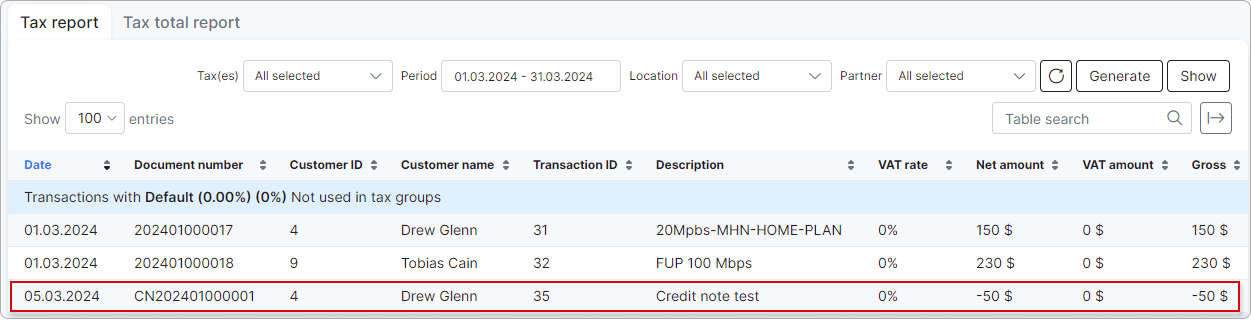
- Invoices contribute positive amounts.
- Credit notes contribute negative amounts. In the Tax report tab, credit note lines display with a leading
-and are highlighted in red on the Net amount, VAT amount, and Gross columns.
All sums use the same rounding strategy as the rest of the finance module, controlled by the Round each finance item setting in Config → Finance → Finance settings. Because the report and the source documents share the same rounding rule, the totals here match the totals you see on the corresponding invoices, credit notes, and other Financial reports.
¶ Filter scope and partner restriction
The Partner filter controls which partner's data is included in the report. If the logged-in admin is bound to a specific partner, the report is automatically restricted to that admin's partner — the Partner filter is locked and cannot be widened. Super administrators (not bound to any partner) can freely combine partners in the filter.
¶ Permissions
The whole Tax summary menu entry is shown only to administrators that have at least one of the two tab permissions. Each tab is gated independently:
- tax-report — shows the Tax report tab.
- tax-total-report — shows the Tax total report tab.
If neither permission is granted, the Tax summary menu entry is hidden. By default the page is allowed only for the Super administrator role; grant the permissions explicitly to other roles in Config → Administration → Roles.
¶ Examples
Month-end VAT filing. At the end of the month, an accountant opens the Tax total report tab in Single mode, sets Period to the closing month, and clicks Show. They get one row per VAT rate with Tax total — exactly what the tax authority needs. They click the export button to download the table as Excel.
Auditing a specific tax. A finance admin notices that the VAT 13% total looks low. They switch to the Tax report tab, pick VAT 13% in the Tax filter, and click Show. The grouped section now lists every invoice and credit note line that contributed to VAT 13%, including lines that came in through tax groups containing VAT 13% — making it easy to spot a missing or refunded document.
¶ Important notes
- Documents are matched to the period by their creation date, not by the date the customer paid. A paid invoice with a creation date outside the period is not included.
- Deleted invoices, deleted credit notes, and deleted line items never appear in the report.
- Credit notes always reduce the totals — they are not shown as separate columns or separate rows in the Tax total tab.
- A line item taxed by a tax group is counted once under the group and once under each component tax in the Tax report tab. This is intentional and is what allows component-tax breakdowns; it is not double-counting (each occurrence reflects a different slice of the same line).
- The Round each finance item setting in Finance settings affects the totals. Two systems with different rounding strategies will produce slightly different totals for the same data.