¶ Internet plans
- Overview
- Creating a plan
- Mass actions
- CAP and FUP rules
- Statistical graph
- Table management and export
- Updating the name and price
- Related pages
¶ Overview
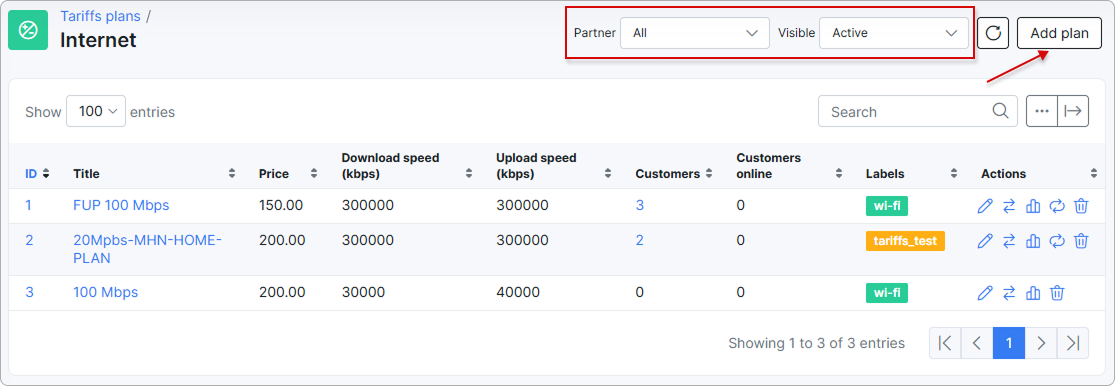
Internet plans define the speed, priority, billing, and availability of the internet services you assign to customers. You manage them in Tariff plans → Internet, where you can filter the list by parameters like Partner or display plans with different visibility statuses.
¶ Creating a plan
To create a new internet plan, go to Tariff plans → Internet and click the Add plan button at the top right of the page.
The Add plan page opens, where you specify the internet plan parameters:
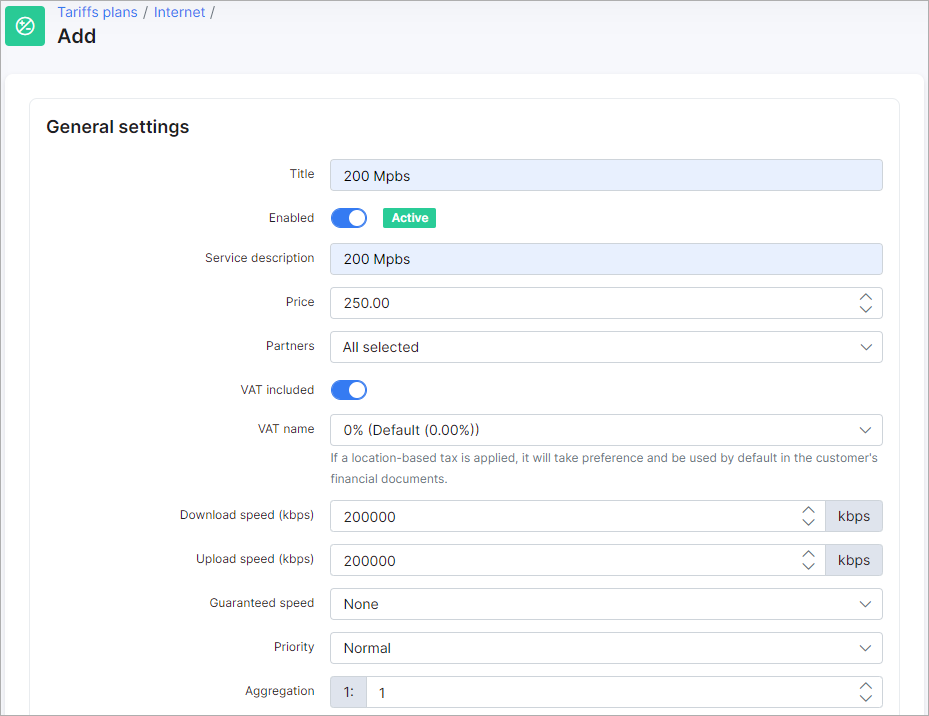
The following options are available:
-
Title — the name of the plan displayed in the list.
-
Enabled — enable or disable this plan. If disabled, you can't create a service with this plan. Previously created services remain active.
-
Service description — the service description (in the customer's internet services list).
-
Price — the price of the service.
-
Labels — select one or more labels to identify this tariff. Labels define the availability of new services for tariff plans in Customer portal ordering and in the Sign-up flow, and are configured on the Labels config page.
-
Partners — select partners who can use this plan.
-
VAT included — select whether the plan's price includes VAT.
-
VAT name — the percentage of the tax.
 First add the tax rate in Config → Finance → Taxes, then select it in the VAT name field. For more information, see Taxes.
-
Download speed (Kbps) — the download speed limit of the internet plan.
-
Upload speed (Kbps) — the upload speed limit of the internet plan.
Values of Download and Upload speeds are MIR (Maximum Information Rate) – best-case scenario, maximum data rate available for flow, if there is any free part of bandwidth. -
Guaranteed speed — the percentage of speed guaranteed to the customer. In most setups, keep it at None. This is the CIR (Committed Information Rate) – worst-case scenario, traffic flows at this rate regardless of other traffic flows, at any given time; the bandwidth should not fall below this committed rate.
-
Priority — the priority of IP packets of the plan. Options are: Low, Normal, High. IP packets of customers subscribed to a plan with High priority are forwarded first in case of congestion. Values are 1 (high), 4 (normal), and 8 (low).
-
Aggregation — how many users share the speed of the plan.
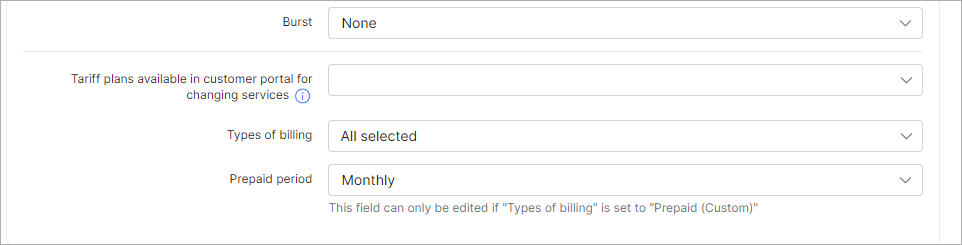
-
Burst — the maximum burst speed allowed. Options are fixed/relative. For details, see Burst speed concept.
-
Burst threshold — the percentage at which burst speeds are enabled/disabled.
-
Burst time — the period of time used in the calculation of Burst values.
-
- Tariff plans available in customer portal for changing services — the list of other tariff plans the customer can switch to from the current tariff on the Customer portal. For more information, read My Services.
 If the customer is on this tariff plan and the Portal configuration permits plan changes, they can select any plan from the dropdown list to switch to.
-
Types of billing — the types of billing the plan is available for.
-
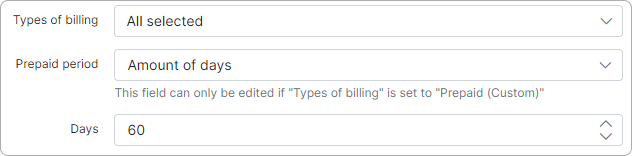
Prepaid period — by default, it is set to Monthly and customers are charged for a period of a month. You can also select Days amount, which shows another field, Prepaid period (days), where you set a custom period in days (7 days (week), 10 days, etc., up to 365 days).
- Exclude traffic classes from accounting — selects traffic classes that Splynx does not count toward the customer's data usage on this tariff.
¶ Plan availability
-
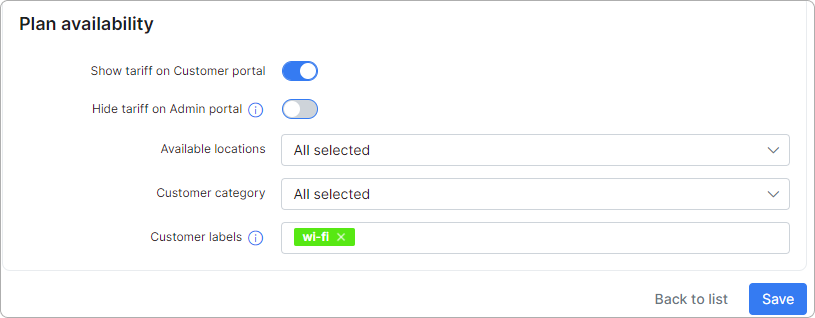
Show tariff on Customer portal — enable this option to make the tariff appear for ordering by customers.
-
Hide tariff on Admin portal — if a customer's location, category, or label does not meet the tariff's criteria, the tariff is not available for selection. When the option is disabled, the settings below apply only to the Customer portal. If the option is enabled, these settings also apply to the Admin portal.
-
Available locations — select available locations.
-
Customer category — select the customer category (Individual, Business, or All).
-
Customer labels — select labels if you want this tariff to be available only for customers with the selected labels. Labels let you efficiently manage which services customers can order on the Customer portal.
-
Connection types — choose one or more connection types to filter tariffs by linking them to coverage maps.
-
Sign-up label — highlight tariff plans on the sign-up website with marketing labels like Best offer, Promotion, etc. Labels can be configured on the Labels config page. See also Sign-up flow.
You can automatically create transaction categories for the respective tariff plan.
To learn more, read Load categories from tariffs.
To learn more, read:
¶ Mass actions
You can change labels and connection types on several internet plans at once. On the Tariff plans → Internet list, select the plans with the checkboxes in the table rows, or select all plans with the checkbox in the table header. Then open the Actions menu and choose an action. The number next to the action shows how many plans are selected.
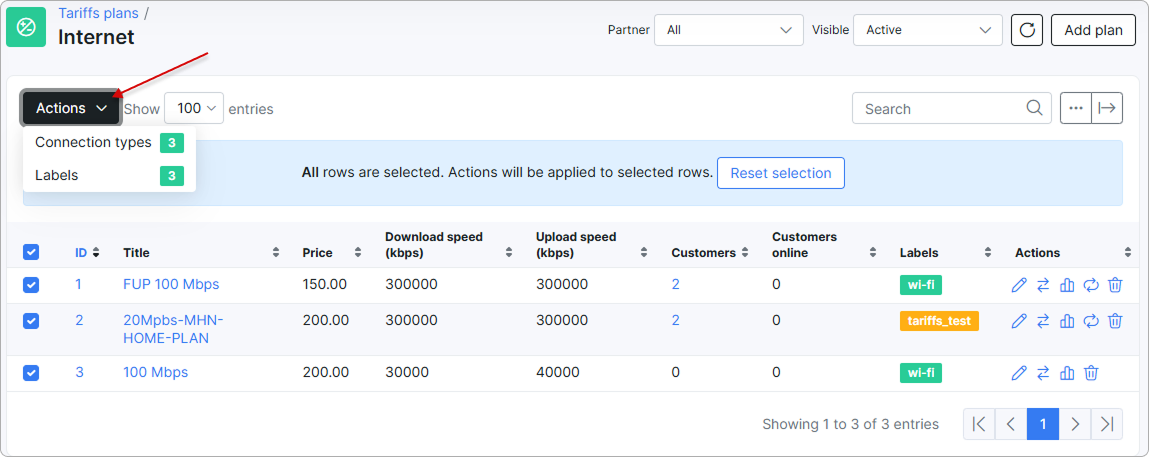
The following mass actions are available for internet plans:
- Labels — adds tariff plan labels and customer labels to the selected plans, or replaces the existing ones.
- Connection types — adds connection types to the selected plans, or replaces the existing ones. Connection types link plans to coverage maps.
For Labels, the Manage labels window opens with two blocks:
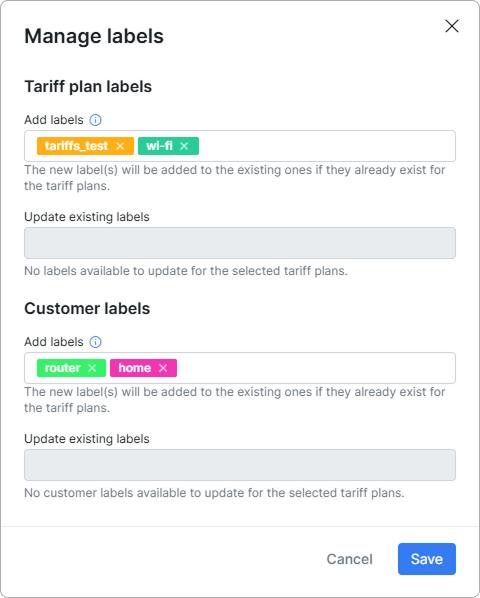
- Add labels — selected by default. Select one or more labels configured for tariff plans on the Labels config page. You can remove any selected label from the field before applying.
- Update existing labels — when enabled, the labels already assigned to the selected plans are replaced with the labels you choose. When disabled, the chosen labels are added to the existing ones.
- Add customer labels — select one or more customer labels. These work the same way as the Customer labels field in the plan's availability settings: the plan is shown for ordering on the Customer portal only to customers with the selected labels.
- Update existing labels — when enabled, the customer labels already assigned to the selected plans are replaced with the labels you choose. When disabled, the chosen labels are added to the existing ones.
The two blocks are independent: you can fill in one of them or both. A block left empty does not change anything on the selected plans.
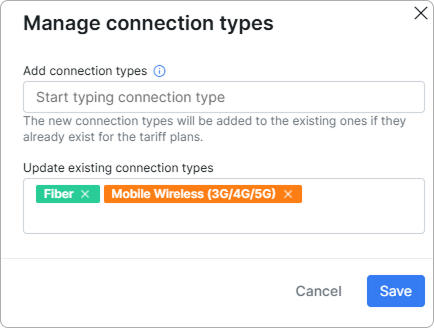
For Connection types, the Manage connection types window opens:
-
Add connection types — start typing to pick one or more connection types. They're added to the selected plans, and any types the plans already have stay as they are. Connection types filter tariffs by linking them to coverage maps. You configure them on the Coverage maps config page.
-
Update existing connection types — shows the connection types already assigned to the selected plans. Remove a type with
×to unassign it from all selected plans.
Click Save to apply the changes.
¶ CAP and FUP rules
Once the internet plan is created, you can configure CAP or FUP rules, see plan usage graphs, and change the plan for all services:
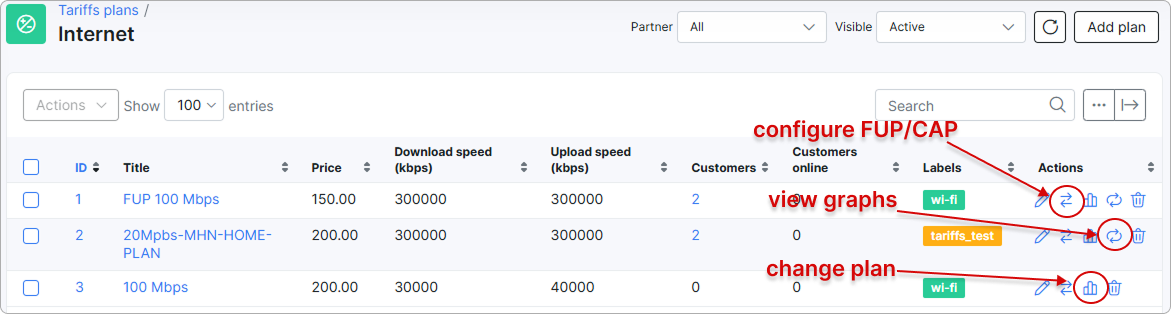
The Change plan icon changes the plan for all customers subscribed to this plan in one operation. For details, see Change plan.
¶ Statistical graph
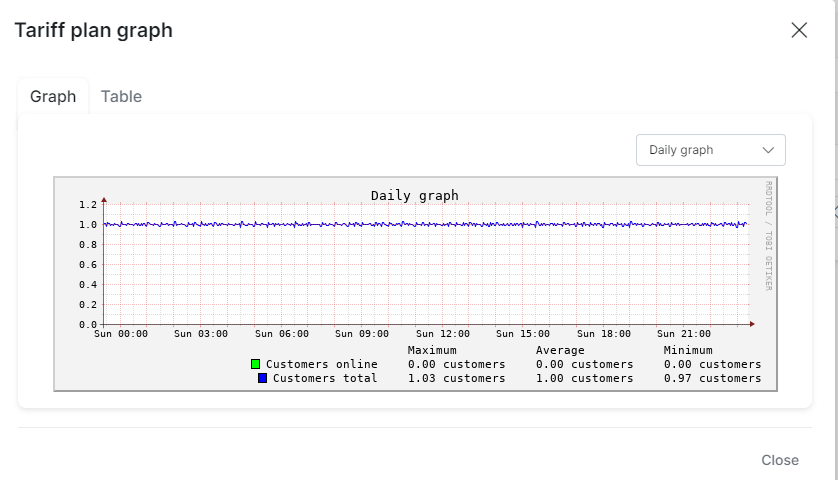
To view a statistical graph of traffic for this plan, click the graph icon in the Actions column. The following window appears:
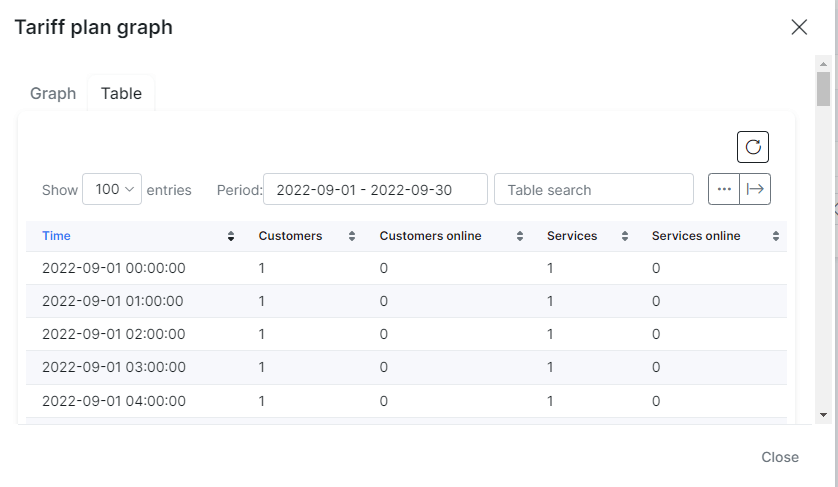
You can also view this data in a table and filter it by a specific period of time:
¶ Table management and export
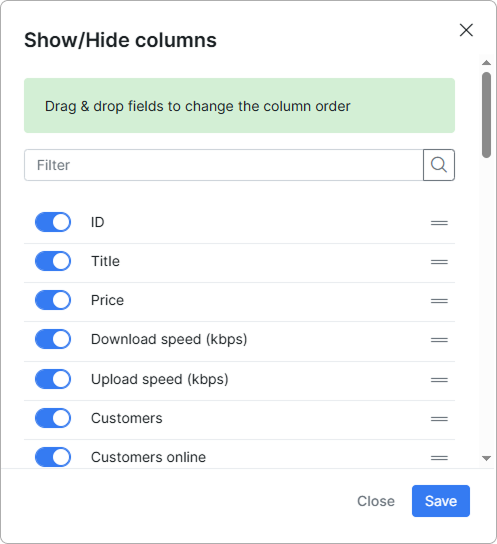
You can export the current view of the plan list and select additional columns to display:
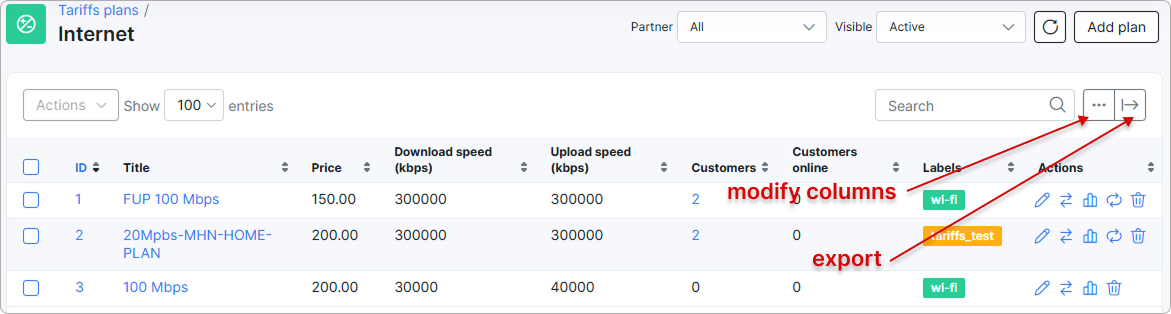
To display new columns, enable them with a toggle and save the changes:
¶ Updating the name and price
To change a plan's description or price, click Edit  next to the plan. The following window opens with additional toggles under the description and price fields:
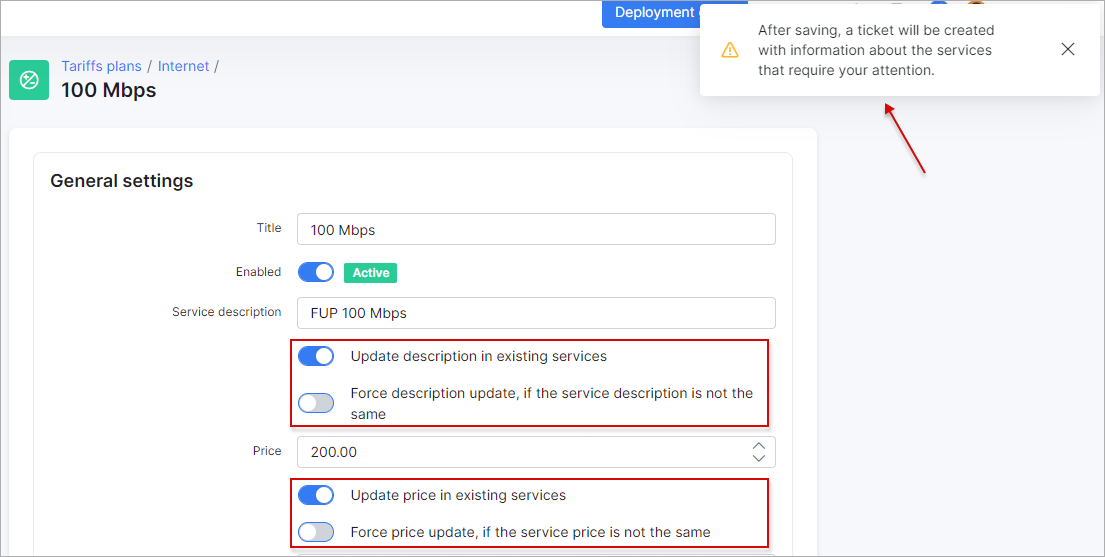
If you need to change the Service description and/or Price but do not want to overwrite changes made to the description and price in customer services subscribed to this tariff plan, enable Update description in existing services. Services are updated only if their description and price match the plan's. If they differ, they remain unchanged.
If you need to change the Service description and/or Price for all services subscribed to this tariff plan, enable Force description/price update, if the service description/price is not the same.
Be careful with the Force description/price update option: all previous changes made in services subscribed to this tariff plan are overwritten.
¶ Related pages
- Customer services — add internet services for customers
- Reports — reports based on plan statistics
- Capped plans and top-ups
- Fair Usage Policy
- Burst speed concept
- Change plan